
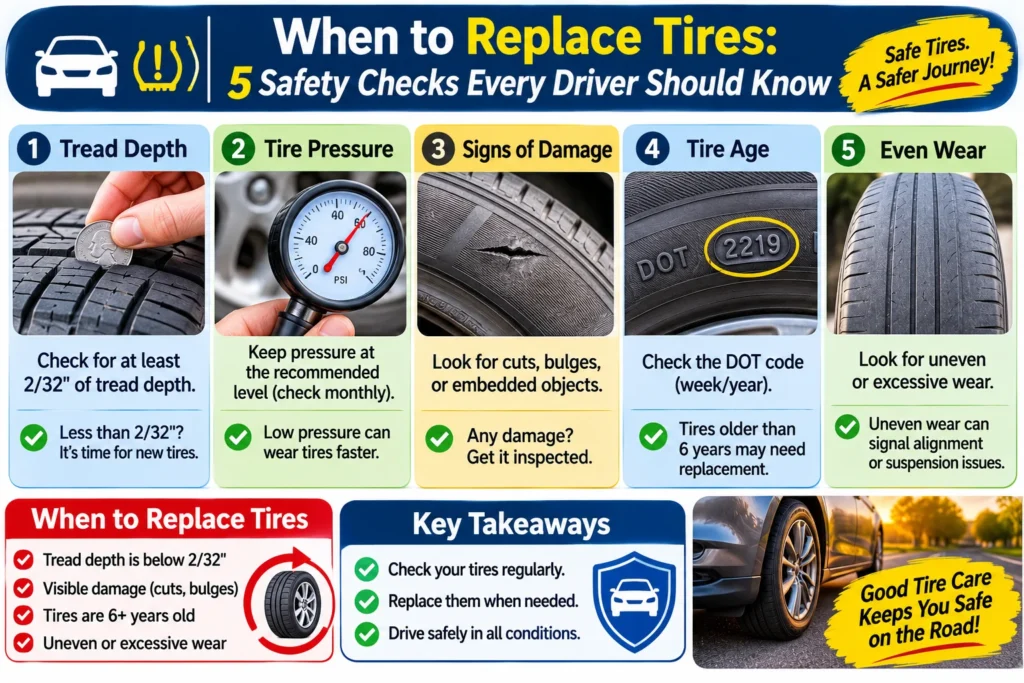
Your tires are the only parts of your vehicle that directly contact the road. Worn tread, aging rubber, or hidden damage can reduce traction, increase stopping distances, and affect vehicle stability.
Knowing when to replace tires helps you avoid unnecessary expenses while maintaining safe driving conditions.
Quick Answer: Replace tires when tread depth reaches 2/32 inch, when serious damage is present, or when manufacturer age limits are reached. Consider replacing them earlier, around 4/32 inch, particularly if you frequently drive on wet roads.
At ShiftAndCruise, our Five-Check Tire Safety Framework helps drivers evaluate tread depth, tire age, visible damage, driving performance, and wear patterns before deciding whether replacement is necessary.
Check Tire Tread Depth Before It Becomes Unsafe
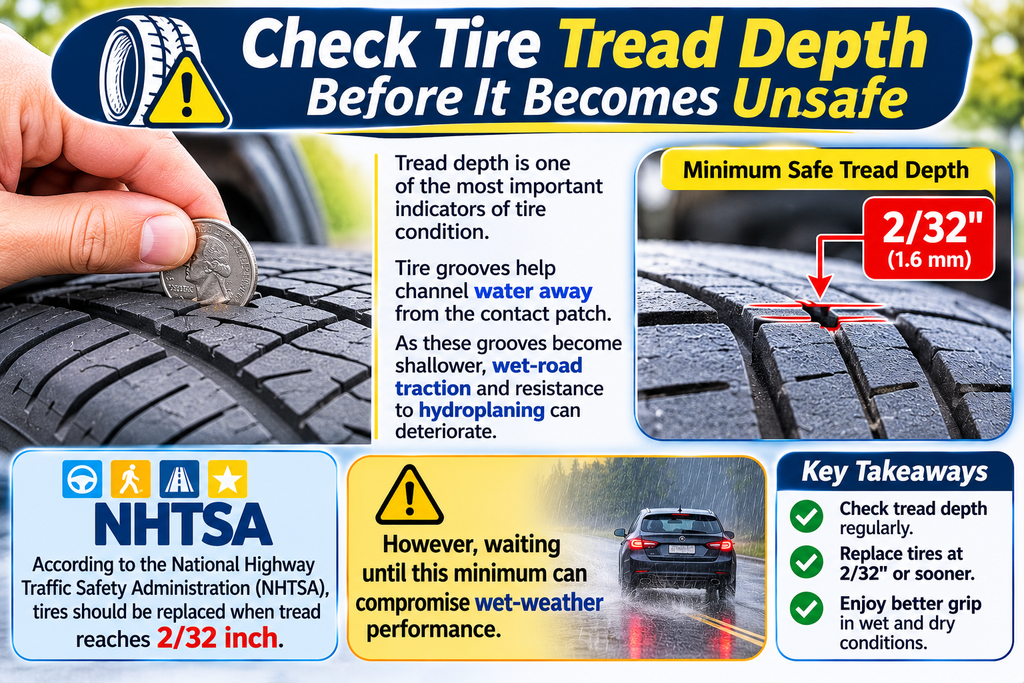
Tread depth is one of the most important indicators of tire condition.
Tire grooves help channel water away from the contact patch. As these grooves become shallower, wet-road traction and resistance to hydroplaning can deteriorate.
According to the National Highway Traffic Safety Administration (NHTSA), tires should be replaced when tread reaches 2/32 inch.
However, waiting until this minimum can compromise wet-weather performance.
Tire Tread Depth Replacement Chart
| Tread depth | Tire condition | Recommended action |
|---|---|---|
| 8/32 inch or more | Substantial tread remaining | Continue regular inspections |
| 6/32 inch | Generally serviceable | Monitor wear |
| 5/32 inch | Moderate tread wear | Check more frequently |
| 4/32 inch | Reduced wet-road safety margin | Plan replacement |
| 3/32 inch | Near minimum | Replace promptly |
| 2/32 inch or less | Worn out | Replace immediately |
These categories are practical guidance, not a guarantee of tire safety at a particular depth.
AAA’s tire replacement guidance recommends considering replacement as tread approaches 4/32 inch.
How to Measure Tire Tread

A tread-depth gauge provides an inexpensive and accurate way to measure remaining tread.
Insert the gauge into several main grooves across each tire, avoiding raised wear indicators.
You can also use the penny test. Insert a penny into a groove with Lincoln’s head facing downward. If the top of his head remains visible, the tread is approximately 2/32 inch or less.
Check multiple locations because tires do not always wear evenly.
Know When Tires Become Too Old

Tires can deteriorate even when they have plenty of tread remaining.
Heat, sunlight, storage conditions, and repeated temperature changes gradually affect rubber compounds.
How Many Years Do Tires Last?
NHTSA notes that some manufacturers recommend replacing tires after six to ten years, regardless of remaining tread.
Michelin recommends professional inspections at least annually after five years of use and replacement by ten years from manufacture.
Always follow your vehicle and tire manufacturer’s specific recommendations.
How to Check Tire Age
Find the DOT identification number on the tire sidewall.
The final four digits indicate the manufacturing week and year.
For example:
DOT ending in 2522 = 25th week of 2022
This identifies the manufacturing date, not the installation date.
Check spare tires too, because rubber deterioration can occur even without regular driving.
Recognize Tire Damage and Uneven Wear

Understanding when to replace tires requires checking their physical condition, not just mileage or tread depth.
Some damage can make a tire unsafe even when the tread appears relatively new.
Sidewall Cracks and Bulges
Cracks may indicate aging or environmental deterioration.
Bulges can signal internal structural damage caused by impacts or other conditions.
A tire with a sidewall bulge should be removed from service and evaluated for replacement rather than repaired.
Uneven Tire Wear

Different wear patterns may indicate underlying vehicle problems.
| Wear pattern | Possible cause |
|---|---|
| Center tread wear | Excessive inflation pressure |
| Both shoulders worn | Underinflation |
| One-sided wear | Alignment or suspension problems |
| Cupping or scalloping | Suspension or balancing issues |
| Localized flat spots | Braking or tire damage |
These patterns suggest possible causes, not confirmed diagnoses.
Correct the underlying problem before fitting replacement tires to avoid repeated premature wear.
Reduced Grip and Unusual Vibrations
Pay attention to changes in driving performance, including:
- Increased slipping on wet roads.
- Longer perceived stopping distances.
- Persistent steering-wheel vibrations.
- Repeated tire-pressure loss.
- Unusual humming or thumping noises.
These symptoms can have several causes. Have the vehicle professionally inspected rather than assuming every problem requires new tires.
Use the Five-Check Tire Replacement Framework
ShiftAndCruise’s Five-Check Framework provides a repeatable method for evaluating tire condition.
The Five-Check Decision Matrix
| Safety check | What to examine | Decision |
|---|---|---|
| Tread | Remaining groove depth | Replace at 2/32 inch; consider earlier |
| Age | DOT manufacturing date | Follow manufacturer limits |
| Damage | Bulges, cracks, punctures | Obtain professional assessment |
| Performance | Grip, vibrations, pressure loss | Diagnose promptly |
| Wear pattern | Uneven or abnormal tread wear | Inspect tires and vehicle |
Should You Replace Two Tires or All Four?
Replacing all four tires together provides a consistent set of tread characteristics.
However, replacing only two may be appropriate when the remaining tires meet the vehicle manufacturer’s requirements.
The U.S. Tire Manufacturers Association recommends installing two new tires on the rear axle to support wet-road stability.
For all-wheel-drive vehicles, differences in tire circumference can affect drivetrain operation. Follow the manufacturer’s permitted tread-depth differences.
How to Extend Tire Life
Regular maintenance can reduce unnecessary tire wear.
- Check cold tire pressure monthly.
- Follow recommended tire rotation intervals.
- Inspect alignment when unusual wear appears.
- Avoid overloading your vehicle.
- Check tread and sidewalls before long trips.
Use the pressure specified on the driver’s door placard or in the owner’s manual.
Final Takeaway: Replace Tires Before Safety Is Compromised
Tire replacement decisions should consider tread depth, age, damage, handling performance, and overall condition.
The 2/32-inch threshold is a minimum replacement point, not an ideal target for drivers who frequently encounter rain or snow.
The safest approach is to inspect tires regularly and address warning signs before they become serious.
Remember: Knowing when to replace tires is not simply about how many miles you have driven. It is about maintaining reliable traction, predictable handling, and safe braking throughout your vehicle’s life.