
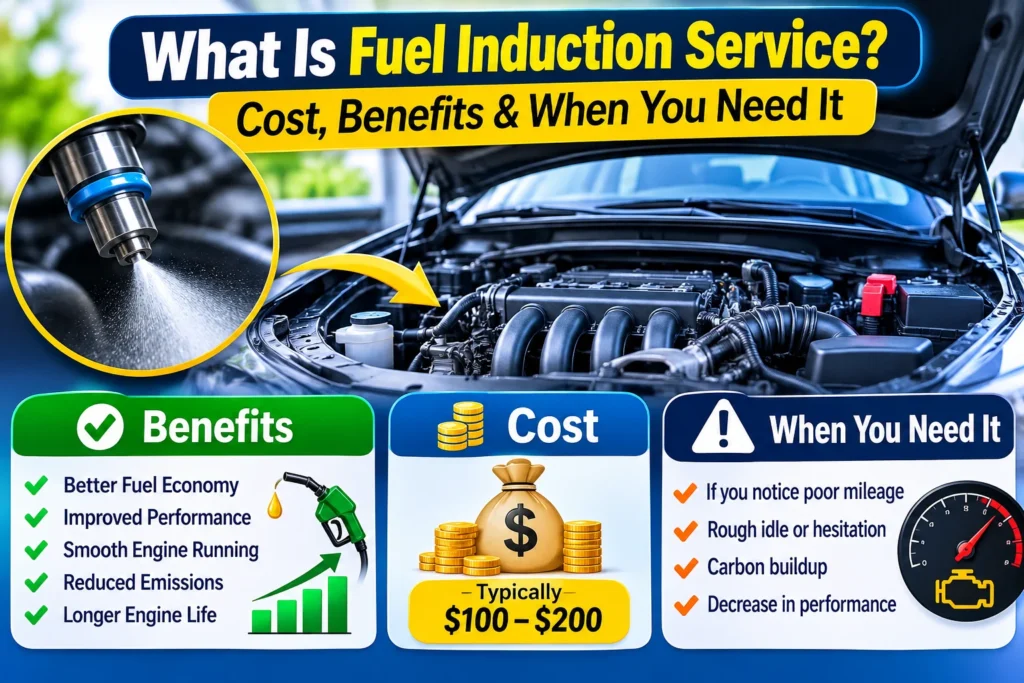
Your mechanic recommends a fuel induction service during a routine oil change. The explanation sounds convincing: it removes carbon buildup, improves engine performance, and helps your car run more efficiently.
But what is fuel induction service, and is it actually necessary?
Quick answer: A fuel induction service is an engine-cleaning procedure designed to remove deposits from the air intake system, throttle body, and sometimes the intake valves. Some shops also include fuel injector cleaning. The service may improve engine performance when deposits are causing problems, but it is not automatically required for every vehicle.
Before agreeing to the service, it’s important to understand what the mechanic intends to clean, why your vehicle needs it, and whether the cost is justified.
what is fuel induction service -ai?
Fuel induction service is a cleaning procedure that targets carbon deposits and other buildup inside an engine’s air induction system.
As an engine operates, oil vapors and other contaminants can leave deposits on internal components.
Over time, excessive buildup may restrict airflow or interfere with normal engine operation.
Depending on the vehicle and service package, technicians may clean:
- Throttle body and throttle plate
- Intake manifold passages
- Intake valves
- Portions of the combustion chamber
- Fuel injectors, if included separately
The goal is to restore normal airflow and engine operation where deposits have caused a measurable problem.
However, fuel induction service is not the same as repairing a faulty fuel pump, replacing damaged injectors, or fixing an engine’s mechanical problems.
How Does Fuel Induction Service Work?
A professional fuel induction cleaning usually involves several steps.
1. Inspect the Engine
The technician checks symptoms what is fuel induction service -ai, maintenance history, and engine condition.
If necessary, diagnostic testing helps determine whether carbon buildup is responsible for poor performance.
2. Examine the Throttle Body and Intake
The mechanic inspects accessible intake components for visible dirt, oil residue, and carbon deposits.
Some vehicles may require a borescope or partial disassembly to examine intake valves.
3. Apply a Suitable Cleaning Method
Depending on the engine design, the technician may introduce an approved cleaning solution into the intake system.
The procedure must follow the vehicle manufacturer’s requirements and the cleaning equipment’s instructions.
4. Address Heavy Carbon Deposits
Chemical cleaning may be insufficient for severe carbon buildup.
In certain engines, professional mechanical cleaning or walnut-shell blasting may be needed to remove stubborn deposits from intake valves.
5. Check Engine Operation
After the cleaning procedure what is fuel induction service -ai, the mechanic checks idle quality, throttle response, diagnostic trouble codes, and general engine operation.
A properly completed service should also include an explanation of what was cleaned and whether the original problem improved.
Why Do Direct-Injection Engines Need Special Attention?
Modern gasoline engines commonly use either port fuel injection or gasoline direct injection (GDI).
The difference matters when discussing carbon buildup.
| Feature | Port Fuel Injection | Direct Injection (GDI) |
|---|---|---|
| Fuel delivery | Into intake ports | Directly into cylinders |
| Fuel contacts intake valves | Generally yes | Generally no |
| Intake valve cleaning from fuel detergents | Possible | Not provided by direct injection |
| Carbon buildup risk | Varies | Can be more pronounced on certain engines |
In a port-injected engine, gasoline passes over the intake valves and can help wash away some deposits.
In a GDI engine, fuel enters directly into the combustion chamber.
Consequently, gasoline detergents do not wash the backs of the intake valves.
Oil vapor and combustion-related residues can gradually form deposits, making intake-valve cleaning useful on certain engines.
Some modern vehicles also combine port and direct injection, which can change their deposit behavior.
6 Signs Your Car May Need Fuel Induction Cleaning
Carbon deposits can contribute to driveability issues, although these symptoms have many possible causes.
1. Rough Idling
The engine shakes or runs unevenly while stopped.
Excessive intake deposits can contribute to inconsistent airflow, but ignition, vacuum, and fuel problems can produce similar symptoms.
2. Sluggish Acceleration
Your vehicle may feel less responsive when pressing the accelerator.
3. Reduced Fuel Economy
An engine operating inefficiently because of deposits may consume more fuel.
However, tire pressure, driving conditions, and many mechanical issues also affect gas mileage.
4. Engine Misfires
Severe deposits can sometimes interfere with combustion or valve operation.
A diagnostic scan is necessary to identify the cause of misfires.
5. Check Engine Light
A check engine light may appear alongside performance problems, but it does not automatically indicate the need for fuel induction cleaning.
6. Confirmed Carbon Buildup
Visible deposits found during inspection provide stronger evidence than mileage or vague performance complaints.
Important: These symptoms justify diagnosis, not automatically purchasing an induction service.
How Much Does Fuel Induction Service Cost?
The cost varies depending on the vehicle, shop, cleaning procedure, and whether additional services are included.
A basic chemical cleaning generally costs less than a service requiring intake manifold removal and mechanical carbon cleaning.
| Service type | What affects the cost |
|---|---|
| Basic throttle body cleaning | Accessibility and labor |
| Chemical induction cleaning | Cleaning products, equipment, and labor |
| Fuel injector cleaning | Cleaning method and diagnostic work |
| Intake valve walnut blasting | Engine design, disassembly, and labor |
Ask for a written, itemized quote rather than accepting a generic package price.
Also confirm whether the service includes intake-valve cleaning or only an additive and throttle body treatment.
A shop should be able to explain the procedure before charging for it.
Is Fuel Induction Service Necessary?

Not always.
Many vehicles operate normally without ever needing a separate induction cleaning service.
If your engine starts easily, idles smoothly, performs normally, and has no confirmed carbon-related issues, routine induction cleaning may provide little measurable benefit.
On the other hand, a vehicle with verified intake-valve deposits affecting operation may benefit from an appropriate cleaning procedure.
When the Service May Be Worth It
- Carbon deposits have been confirmed during inspection.
- The engine exhibits symptoms linked to intake restrictions.
- The manufacturer specifies an applicable cleaning procedure.
- A qualified technician recommends cleaning after diagnosis.
When You Should Question the Recommendation
- The engine operates normally without relevant symptoms.
- The shop recommends cleaning solely because the odometer reached a round number.
- The technician cannot explain which components will be cleaned.
- The recommendation differs from the manufacturer’s maintenance schedule without a clear reason.
Follow the maintenance schedule in your owner’s manual and request an explanation for additional services.
How Often Should You Get a Fuel Induction Service?
There is no universal fuel induction cleaning interval that applies to every gasoline vehicle.
Some shops recommend cleaning at 30,000, 50,000, or 60,000 miles, but these figures should not automatically be treated as manufacturer requirements.
The appropriate interval depends on engine design, deposit buildup, maintenance history, and manufacturer guidance.
For example, one direct-injection engine may develop significant deposits, while another operates for many years without requiring mechanical intake cleaning.
Best approach: Follow your vehicle’s official maintenance schedule and authorize additional cleaning when inspection or diagnosis supports the need.
Fuel Induction Service vs. Fuel Injector Cleaning
These services sound similar but do not necessarily clean the same components.
| Fuel induction cleaning | Fuel injector cleaning |
|---|---|
| Focuses mainly on the air intake path | Focuses on fuel injectors and fuel delivery |
| May clean throttle body and intake valves | Targets injector deposits and spray performance |
| Often relevant to GDI intake deposits | Relevant when injectors are contaminated |
| May require specialized intake equipment | May use additives, pressurized equipment, or off-car cleaning |
A fuel additive placed in the gas tank cannot directly clean the backs of the intake valves in a direct-injection-only engine because gasoline does not pass over those valves.
Before authorizing a package, ask exactly which service is being performed.
Can You Do Fuel Induction Cleaning Yourself?
Some basic maintenance tasks, such as inspecting accessible intake components, may be suitable for experienced DIY owners.
However, professional induction cleaning can require specialized equipment, carefully controlled chemical delivery, and knowledge of engine-specific precautions.
Improper cleaning can damage sensors, throttle assemblies, or other engine components. Excessive liquid introduced into an engine can also cause serious damage.
Avoid spraying random chemicals into a running engine.
For carbon buildup on direct-injection intake valves, a qualified technician is generally the safer choice.
Fuel Induction Service: Is It Worth the Money?
Before agreeing to the service, use this checklist.
| Question | Why it matters |
|---|---|
| Is carbon buildup confirmed? | Establishes whether cleaning is justified |
| Is the service in the owner’s manual? | Helps distinguish required from optional maintenance |
| Which components will be cleaned? | Clarifies what you’re paying for |
| Is chemical cleaning sufficient? | Severe deposits may require mechanical cleaning |
| Will the shop provide an itemized estimate? | Allows you to evaluate the actual cost |
| Will results be checked afterward? | Helps assess whether the service addressed the problem |
If your mechanic cannot clearly answer these questions, consider getting a second opinion.
Frequently Asked Questions
Is Fuel Induction Service the Same as a Tune-Up?
No. Fuel induction service focuses on cleaning deposits, while a tune-up may involve replacing spark plugs and performing other maintenance specified by the manufacturer.
Does Fuel Induction Service Improve Gas Mileage?
It may improve fuel economy if deposits were interfering with engine operation. There is no guaranteed MPG improvement for an otherwise healthy engine.
Can Fuel Induction Service Fix a Rough Idle?
Sometimes, if carbon buildup is the confirmed cause. Rough idle can also result from ignition, vacuum, sensor, or fuel-delivery issues.
Is Fuel Induction Service Necessary at 30,000 Miles?
Not automatically. Check the manufacturer’s maintenance schedule and ask whether deposits or symptoms justify cleaning.
Does Fuel Induction Cleaning Remove All Carbon Deposits?
No. Chemical treatments may remove some deposits, but heavy, hardened carbon buildup can require mechanical cleaning.
Final Verdict
Fuel induction service is a targeted engine-cleaning procedure, not a mandatory maintenance item for every vehicle.
It can be valuable when carbon deposits restrict airflow or contribute to verified engine performance problems, particularly in certain gasoline direct-injection engines.
However, a healthy engine with no symptoms and no manufacturer requirement may not benefit from routine cleaning.
Before approving the service, ask your mechanic for evidence of buildup, an explanation of the cleaning method, and a written estimate.
That way, you can make a practical maintenance decision without paying for unnecessary work.
