
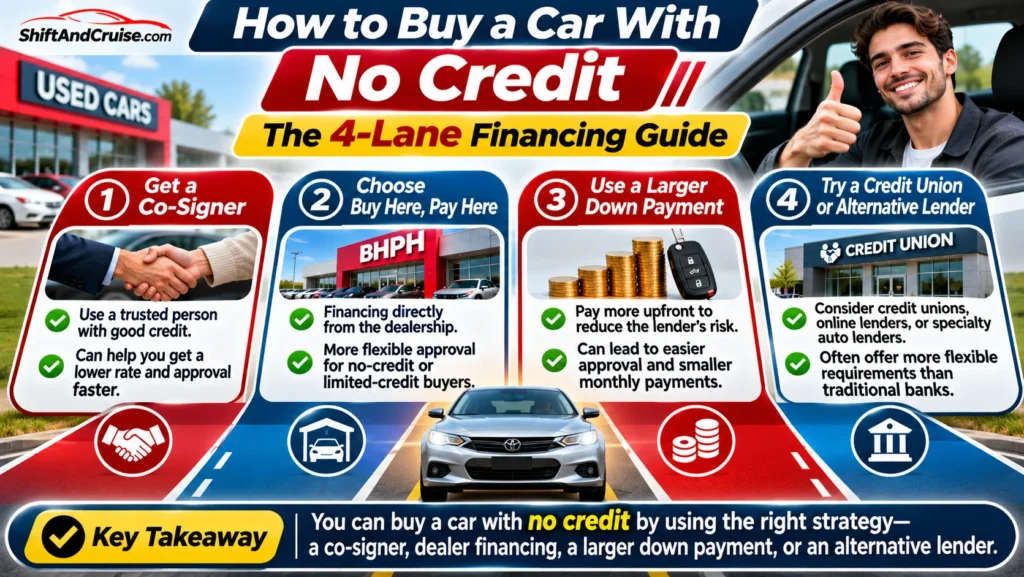
Buying your first car can be challenging when you have no credit history. Lenders often rely on credit reports to evaluate borrowing risk, making loan approval more difficult for first-time buyers.
However, learning how to buy a car with no credit can help you explore financing options without accepting unnecessarily expensive loan terms.
Quick Answer: You can purchase a car without an established credit history by paying cash, applying through a bank or credit union, using a qualified co-signer, or exploring dealership financing. A stable income, affordable vehicle, and larger down payment may improve your chances of approval.
At ShiftAndCruise, our 4-Lane Financing Framework helps first-time buyers compare these options based on affordability, approval requirements, and financial risk.
Can You Get a Car Loan With No Credit History?
Yes. Having no credit history does not automatically disqualify you from obtaining an auto loan.
However, lenders may view applicants without established repayment records as higher-risk borrowers.
According to the Consumer Financial Protection Bureau (CFPB), auto lenders consider several factors when determining interest rates and loan eligibility.
These include:
- Income: Reliable earnings demonstrate your ability to make payments.
- Employment history: Consistent employment may strengthen your application.
- Down payment: Paying more upfront reduces the amount borrowed.
- Existing debts: Lower financial obligations may improve affordability.
- Vehicle price: An affordable car requires less financing.
- Loan duration: Repayment terms influence monthly payments and borrowing costs.
No Credit vs. Bad Credit: What’s the Difference?
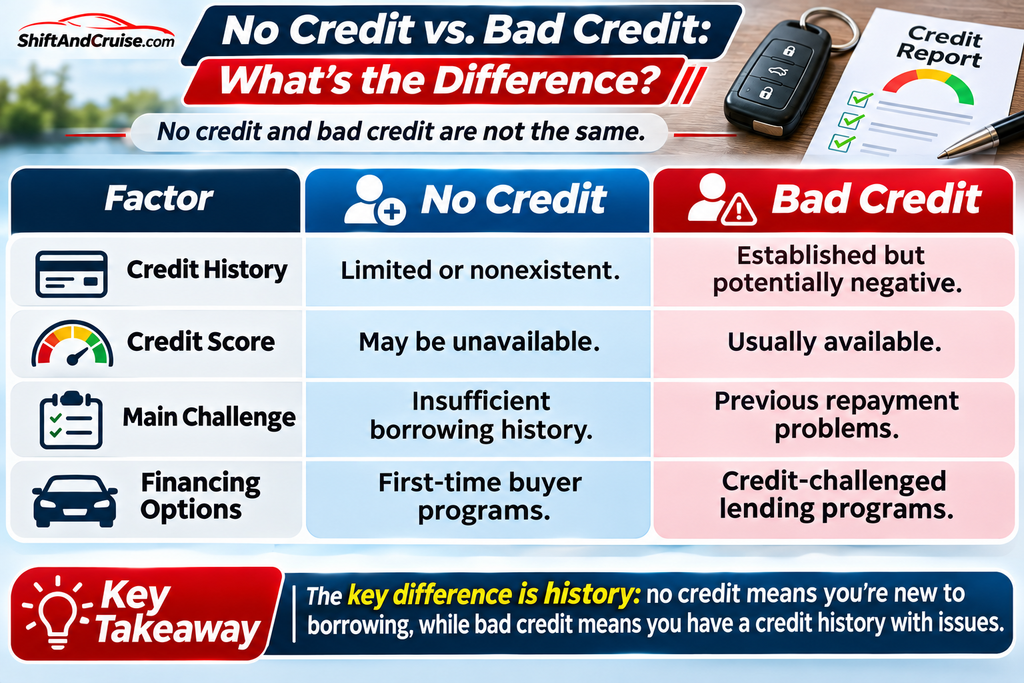
No credit and bad credit are not the same.
| Factor | No credit | Bad credit |
|---|---|---|
| Credit history | Limited or nonexistent | Established but potentially negative |
| Credit score | May be unavailable | Usually available |
| Main challenge | Insufficient borrowing history | Previous repayment problems |
| Financing options | First-time buyer programs | Credit-challenged lending programs |
A first-time buyer without a credit score may still qualify for financing based on income, down payment, and lender requirements.
Before applying, review your available credit reports through AnnualCreditReport.com to confirm your actual credit status.
The 4-Lane Framework: Ways to Finance a Car Without Credit
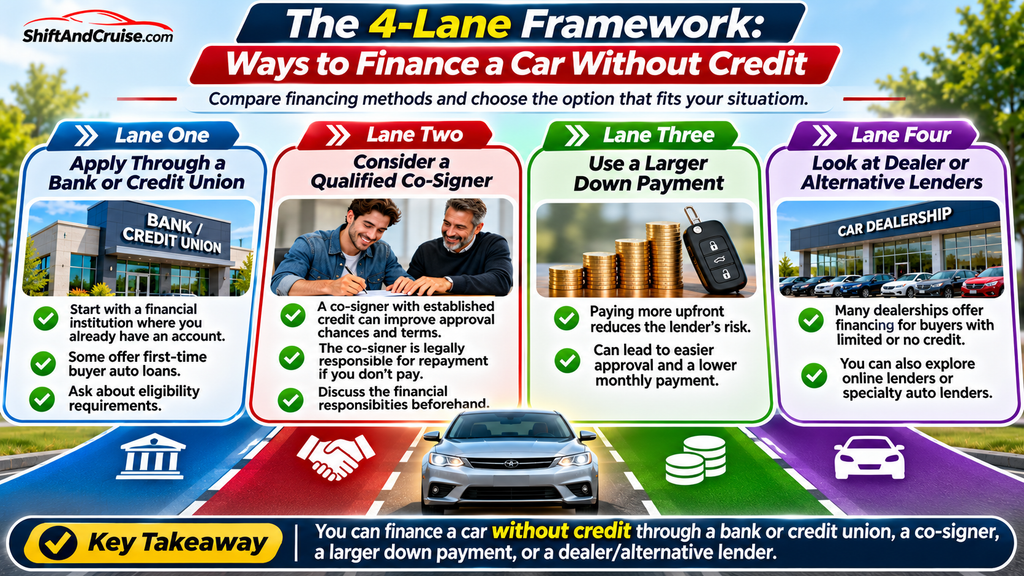
Understanding how to buy a car with no credit starts with comparing financing methods rather than accepting the first available offer.
Lane One: Apply Through a Bank or Credit Union
Start with a financial institution where you already have an account.
Some banks and credit unions consider applicants with limited credit histories, particularly when they demonstrate consistent income and responsible account management.
Ask whether first-time buyer auto loans are available and request information about eligibility requirements.
Lane Two: Consider a Qualified Co-Signer
A co-signer with established credit may improve loan approval chances and help you qualify for better terms.
However, the co-signer becomes legally responsible for repayment if you fail to pay.
Late payments or defaults can damage both borrowers’ credit.
Never use a co-signer without discussing these financial responsibilities.
Lane Three: Compare Dealership Financing
Dealerships can arrange financing through banks, credit unions, and other lenders.
Some offer programs designed for first-time buyers or recent graduates.
However, dealership-arranged financing does not guarantee the lowest interest rate.
The FTC’s auto financing guidance recommends comparing lender offers before visiting a dealership.
Lane Four: Pay Cash or Consider Alternative Financing
Buying an affordable vehicle with cash eliminates loan interest and credit approval requirements.
Buy-here-pay-here dealerships may also finance buyers without established credit.
However, the CFPB warns that these dealerships often charge higher interest rates, and some may not report positive payments to credit bureaus.
Financing Options Comparison
| Financing method | Main advantage | Potential drawback |
|---|---|---|
| Bank or credit union | Competitive offers may be available | Approval requirements |
| Co-signer loan | May improve approval odds | Shared financial responsibility |
| Dealership financing | Multiple financing sources | Possible rate markup |
| Cash purchase | No loan interest | Requires upfront savings |
| Buy-here-pay-here | Alternative approval process | Often higher borrowing costs |
How to Improve Your Chances of Getting Approved
You can strengthen your application even without a traditional credit score.
Save for a Larger Down Payment
A larger down payment reduces the amount financed and can improve your application.
For example, a $3,000 down payment on a $15,000 vehicle reduces the purchase amount requiring financing to $12,000, before taxes and fees.
There is no universally required down-payment percentage. Requirements vary by lender and vehicle.
Prepare Your Financial Documents
Use ShiftAndCruise’s Three-Proof Application Checklist before contacting lenders.
| Required evidence | Example documentation |
|---|---|
| Identity and residence | Government ID and address verification |
| Income stability | Pay stubs or other income records |
| Financial readiness | Bank statements and down-payment funds |
Individual lenders may request additional documents.
Choose an Affordable Vehicle
Consider reliable used vehicles rather than expensive models with higher payments.
Review maintenance history, vehicle condition, insurance costs, and repair needs.
Arrange an independent mechanical inspection before buying a used car.
Compare Loan Offers Within a Short Period
Request prequalification when available and ask whether it involves a soft or hard credit inquiry.
The CFPB explains that multiple auto-loan inquiries within approximately 14–45 days may count as one inquiry under certain scoring models.
Compare annual percentage rates (APR), loan terms, fees, and total repayment amounts.
Understand the Real Cost Before Signing
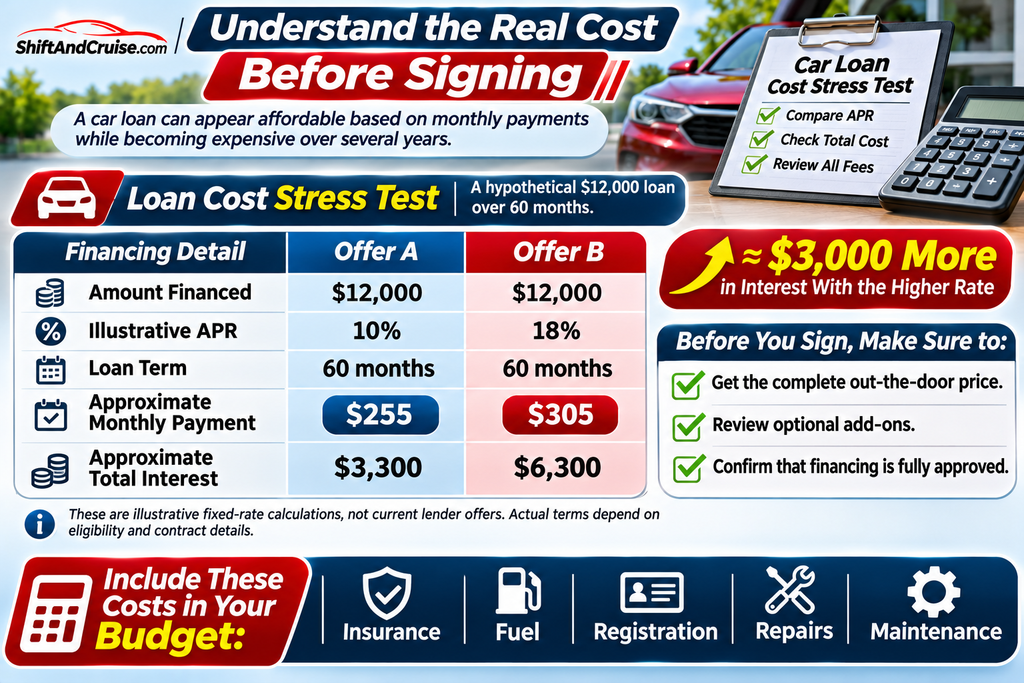
A car loan can appear affordable based on monthly payments while becoming expensive over several years.
ShiftAndCruise’s Loan Cost Stress Test illustrates why interest rates matter.
Consider a hypothetical $12,000 loan over 60 months:
| Financing detail | Offer A | Offer B |
|---|---|---|
| Amount financed | $12,000 | $12,000 |
| Illustrative APR | 10% | 18% |
| Loan term | 60 months | 60 months |
| Approximate monthly payment | $255 | $305 |
| Approximate total interest | $3,300 | $6,300 |
These are illustrative fixed-rate calculations, not current lender offers. Actual terms depend on eligibility and contract details.
The higher-rate loan costs approximately $3,000 more in interest.
Before signing, obtain the complete out-the-door price, review optional add-ons, and confirm that financing is fully approved.
Include insurance, fuel, registration, repairs, and maintenance in your budget.
Final Takeaway: Buying a Car Without Credit Is Possible
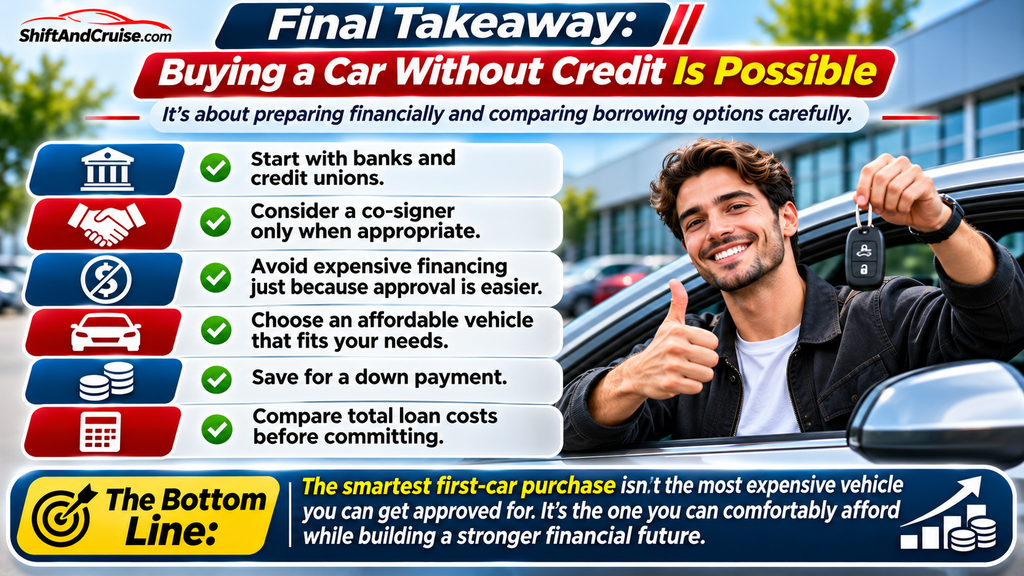
Learning how to buy a car with no credit is about preparing financially and comparing borrowing options carefully.
Start with banks and credit unions, consider a co-signer only when appropriate, and avoid expensive financing simply because approval appears easier.
Choose an affordable vehicle, save for a down payment, and compare total loan costs before committing.
The smartest first-car purchase isn’t the most expensive vehicle you can get approved for. It’s the one you can comfortably afford while building a stronger financial future.