
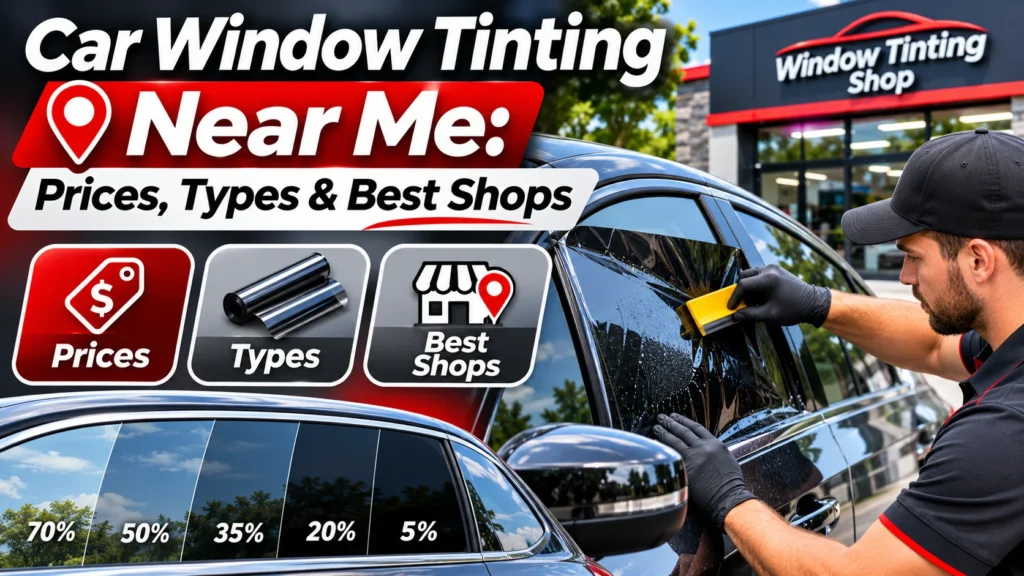
Car window tinting can improve driving comfort, reduce sun glare, protect interior materials, and provide additional privacy. However, choosing the cheapest installer without checking film quality, warranty coverage, or local regulations can lead to disappointing results.
If you’re searching for car window tinting near me, focus on finding a reputable installer that offers suitable window films, transparent pricing, and professional workmanship.
Quick Answer: The best way to find a reliable car tinting shop is to compare local customer reviews, verify the film brand, request written quotes, and confirm the installation complies with state laws. Ceramic films often provide stronger heat rejection, while dyed and carbon films offer more affordable alternatives.
At ShiftAndCruise, we recommend the Four-Point Tint Shop Framework to help drivers evaluate installers before booking an appointment.
How to Find a Reliable Car Window Tinting Shop

Not every automotive tinting business offers the same materials, installation standards, or warranty protection.
A professional installer should explain available films, demonstrate different tint shades, and provide clear information about pricing and maintenance.
Search for Local Tinting Specialists
Start by searching Google Maps for nearby automotive window tinting businesses.
Compare several shops rather than selecting the first sponsored listing.
Look for:
- Recent customer reviews describing installation quality.
- Photos of completed vehicles.
- Experience with your vehicle type.
- Clear information about film brands.
- Written warranty coverage.
- Transparent pricing and installation details.
Pay particular attention to complaints about bubbling, peeling edges, dust beneath the film, and unresolved warranty claims.
Verify Authorized Installers
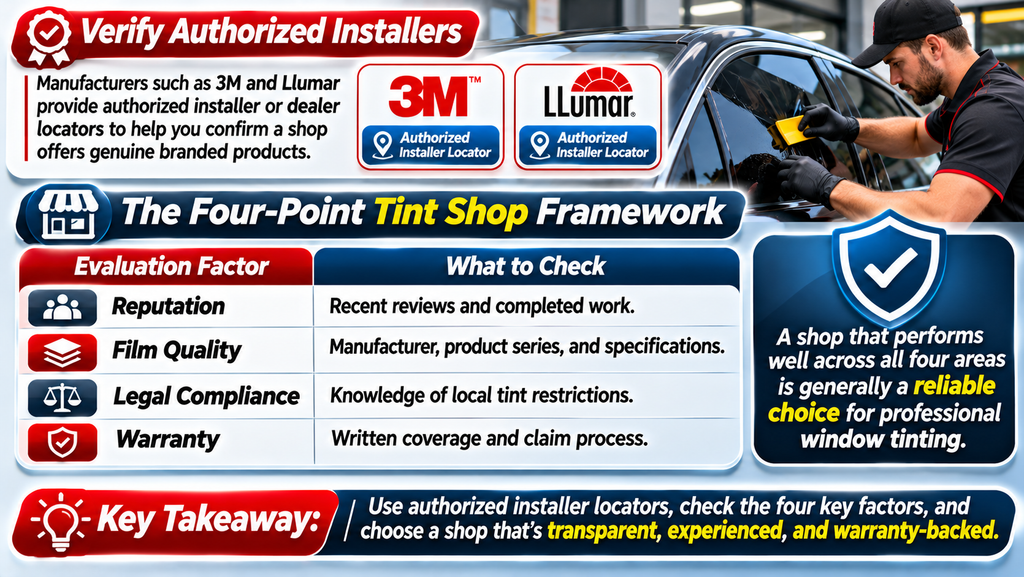
Manufacturers such as 3M and LLumar provide authorized installer or dealer locators.
These resources can help verify whether a shop offers genuine branded products.
The Four-Point Tint Shop Framework
| Evaluation factor | What to check |
|---|---|
| Reputation | Recent reviews and completed work |
| Film quality | Manufacturer, product series, specifications |
| Legal compliance | Knowledge of local tint restrictions |
| Warranty | Written coverage and claim process |
A shop that performs well across all four areas is generally worth considering, even if its quote is not the lowest.
Which Type of Car Window Tint Is Best?
Different window films offer different levels of heat rejection, appearance, durability, and cost.
Understanding these differences helps prevent paying for features you do not need.
Dyed Window Tint
Dyed film is typically among the more affordable options.
It can reduce glare and improve privacy, but heat rejection and long-term color stability depend on the product.
Carbon Window Tint
Carbon films generally offer improved heat control and color stability compared with basic dyed products.
They can provide a useful balance between performance and affordability.
Ceramic Window Tint
Ceramic films use nonmetallic materials designed to reject solar heat while maintaining visibility.
Some premium ceramic films deliver strong infrared rejection without interfering with mobile or GPS signals.
Window Tint Comparison Chart
| Film type | Main advantage | Main consideration |
|---|---|---|
| Dyed | Affordable privacy | Limited heat performance |
| Carbon | Balanced performance | Higher cost than basic dyed |
| Ceramic | Strong heat rejection | Higher purchase price |
| Premium multilayer | Advanced solar control | Premium pricing |
Performance varies by manufacturer and product series.
Understand VLT and Heat Rejection
Visible Light Transmission (VLT) measures how much visible light passes through the glass and film.
A lower percentage means darker tint.
However, darker film does not automatically provide better heat rejection.
According to 3M’s automotive film guidance, Total Solar Energy Rejection (TSER) describes how much total solar energy the filmed glass rejects.
Compare TSER, VLT, UV rejection, and warranty coverage rather than relying on darkness alone.
How Much Does Professional Car Window Tinting Cost?
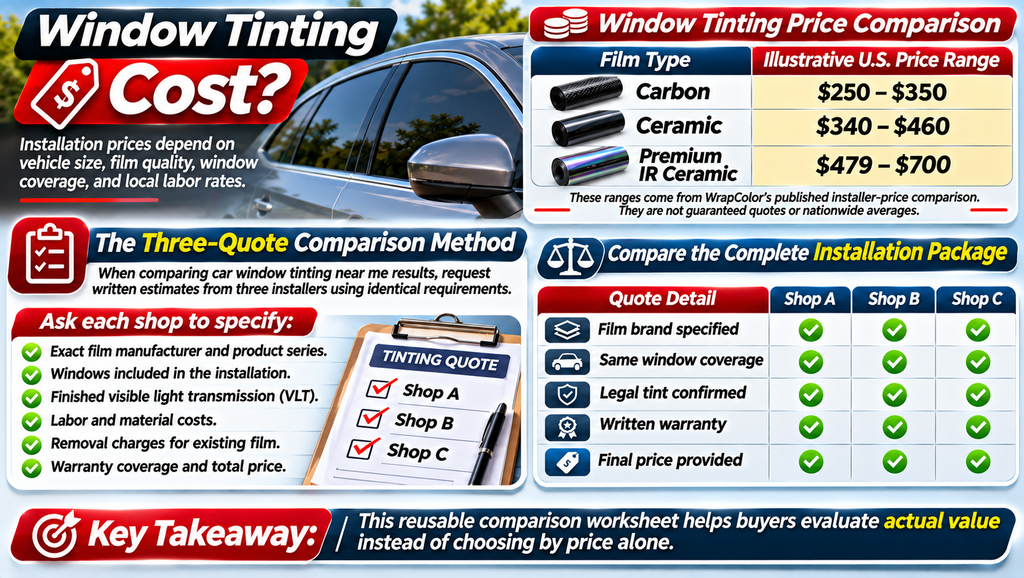
Installation prices depend on vehicle size, film quality, window coverage, and local labor rates.
A recent comparison of published U.S. installer prices found the following typical ranges for a sedan’s side and rear windows.
Window Tinting Price Comparison
| Film type | Illustrative U.S. price range |
|---|---|
| Carbon | $250–$350 |
| Ceramic | $340–$460 |
| Premium IR ceramic | $479–$700 |
These ranges come from WrapColor’s published installer-price comparison. They are not guaranteed quotes or nationwide averages.
SUVs, larger vehicles, windshield installations, and old-film removal may cost more.
The Three-Quote Comparison Method
When comparing car window tinting near me results, request written estimates from three installers using identical requirements.
Ask each shop to specify:
- Exact film manufacturer and product series.
- Windows included in the installation.
- Finished visible light transmission.
- Labor and material costs.
- Removal charges for existing film.
- Warranty coverage and total price.
Compare the Complete Installation Package
| Quote detail | Shop A | Shop B | Shop C |
|---|---|---|---|
| Film brand specified | Check | Check | Check |
| Same window coverage | Check | Check | Check |
| Legal tint confirmed | Check | Check | Check |
| Written warranty | Check | Check | Check |
| Final price provided | Check | Check | Check |
This reusable comparison worksheet helps buyers evaluate actual value instead of choosing by price alone.
Check Tint Laws and Installation Quality Before Booking
Window tint regulations vary between U.S. states and can differ for front windows, rear windows, and windshields.
The National Highway Traffic Safety Administration explains that federal glazing safety requirements also affect certain professional vehicle modifications.
State laws establish additional restrictions for vehicles operated on public roads.
Confirm Your State’s Legal Tint Limits
Before booking, check your state’s official DMV, highway patrol, or vehicle-code guidance.
Ask the installer to verify the finished glass-and-film VLT using a tint meter.
Factory-tinted glass already reduces light transmission, so adding film can make the finished window darker than the film’s advertised rating.
Never assume a tint percentage is legal simply because another vehicle uses it.
Inspect the Finished Installation
Before leaving the shop, check for:
- Clearly visible trapped dirt or debris.
- Uneven film edges.
- Lifting or peeling corners.
- Scratches or damage around window trim.
- Incorrect film coverage.
Some temporary moisture or haze may appear during curing.
However, persistent bubbles or peeling should be evaluated by the installer.
Follow Proper Tint Aftercare
Window film needs time to cure after installation.
Many installers recommend keeping windows closed for several days and avoiding immediate cleaning.
Follow the specific instructions supplied with your film.
For example, LLumar’s care guidance explains warranty requirements and directs customers to authorized dealers for product support.
Avoid abrasive cleaning tools and use products approved by the film manufacturer.
Final Takeaway: Choose Quality, Safety, and Value

Finding the right window tinting service requires more than comparing advertised prices.
A trustworthy installer should offer genuine products, clear performance information, legal installation options, and written warranty protection.
When researching car window tinting near me, compare at least three local shops and evaluate their materials, workmanship, and complete installation costs.
The best tinting service isn’t necessarily the cheapest. It’s the one that delivers reliable heat protection, comfortable visibility, professional installation, and lasting value.