
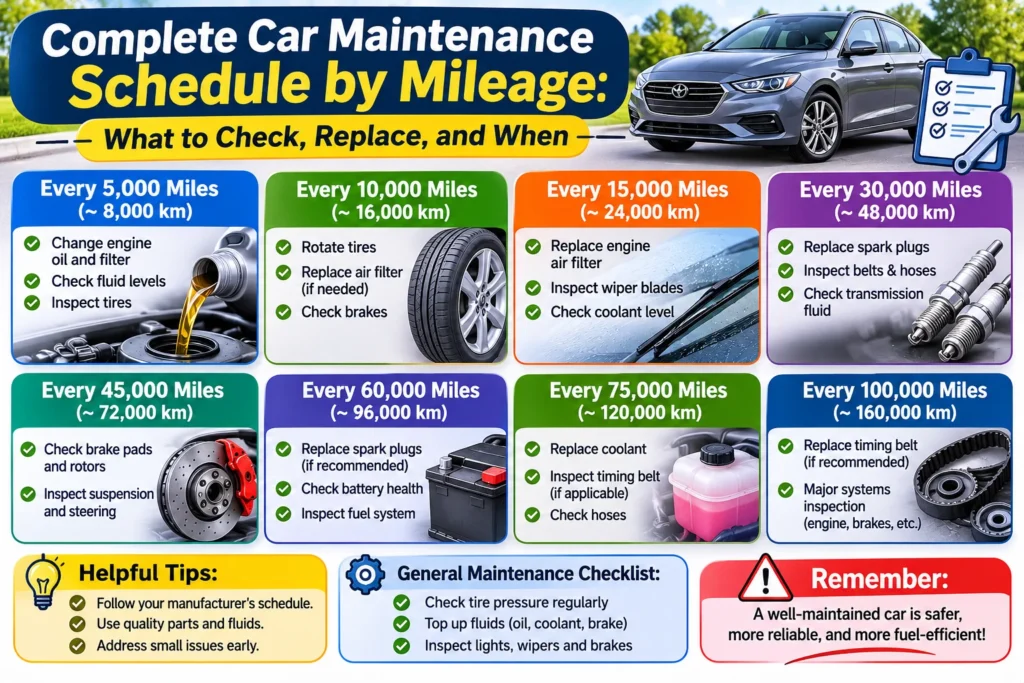
Regular vehicle maintenance helps prevent unexpected breakdowns, improve safety, and reduce unnecessary repair expenses. However, knowing when to replace fluids, inspect components, and schedule major services can be confusing.
A car maintenance schedule by mileage provides a practical way to track essential services as your vehicle accumulates miles.
Quick Answer: Most vehicles need routine inspections, oil changes, and tire rotations approximately every 5,000–10,000 miles, depending on manufacturer recommendations. More comprehensive inspections commonly occur around 30,000, 60,000, and 90,000 miles.
At ShiftAndCruise, we recommend the Mileage–Time–Condition Framework to help drivers maintain their vehicles without paying for unnecessary services.
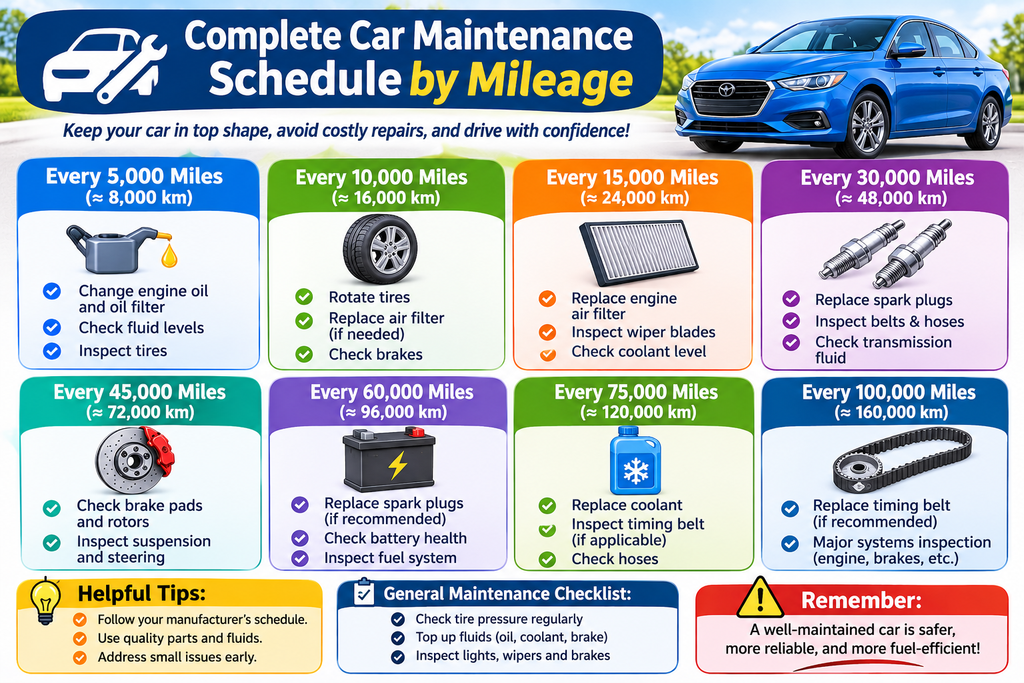
Always prioritize your vehicle’s owner’s manual, manufacturer maintenance reminders, and recommended service intervals.
Complete Car Maintenance Schedule by Mileage
Vehicle maintenance requirements change as components experience wear, heat, vibration, and repeated use.
The following mileage chart provides general guidance for gasoline-powered passenger vehicles.
Vehicle Maintenance Mileage Chart
| Mileage | Recommended maintenance |
|---|---|
| Every 5,000 miles | Check oil service requirements, rotate tires if due, inspect brakes |
| 10,000 miles | Review oil and filter service, tire condition, fluid levels |
| 15,000 miles | Inspect engine and cabin air filters, brakes, suspension |
| 30,000 miles | Review filter replacements, brake fluid, transmission service requirements |
| 60,000 miles | Inspect belts, hoses, cooling system, transmission, suspension |
| 90,000 miles | Review spark plug and timing belt requirements, inspect major components |
| 100,000 miles | Perform comprehensive inspection and complete manufacturer-scheduled services |
| 150,000+ miles | Continue scheduled maintenance and monitor age-related component wear |
These are planning checkpoints, not universal replacement deadlines. Actual service requirements vary by vehicle.
According to AAA’s maintenance guidance, routine services often occur around 5,000–7,500 miles, with more extensive maintenance performed at longer intervals.
Every 5,000 to 10,000 Miles
Routine maintenance typically includes:
- Engine oil and filter replacement when due.
- Tire rotation according to manufacturer instructions.
- Brake inspection.
- Tire pressure and tread examination.
- Fluid-level and leak checks.
Oil-change intervals vary significantly. Some vehicles require servicing near 5,000 miles, while others permit longer intervals.
At 30,000 to 60,000 Miles
As mileage increases, additional inspections become important.
Check engine air filters, cabin filters, transmission fluid requirements, drive belts, suspension components, and cooling-system condition.
Replace components only when required by the vehicle’s schedule or inspection findings.
At 90,000 to 150,000 Miles
Higher-mileage maintenance may involve spark plugs, coolant, timing belts, and aging suspension components.
Consumer Reports’ maintenance guide identifies timing-belt replacement intervals commonly ranging from 60,000 to 120,000 miles on vehicles equipped with these belts.
Vehicles using timing chains may have different requirements.
Why Mileage Alone Cannot Determine Maintenance
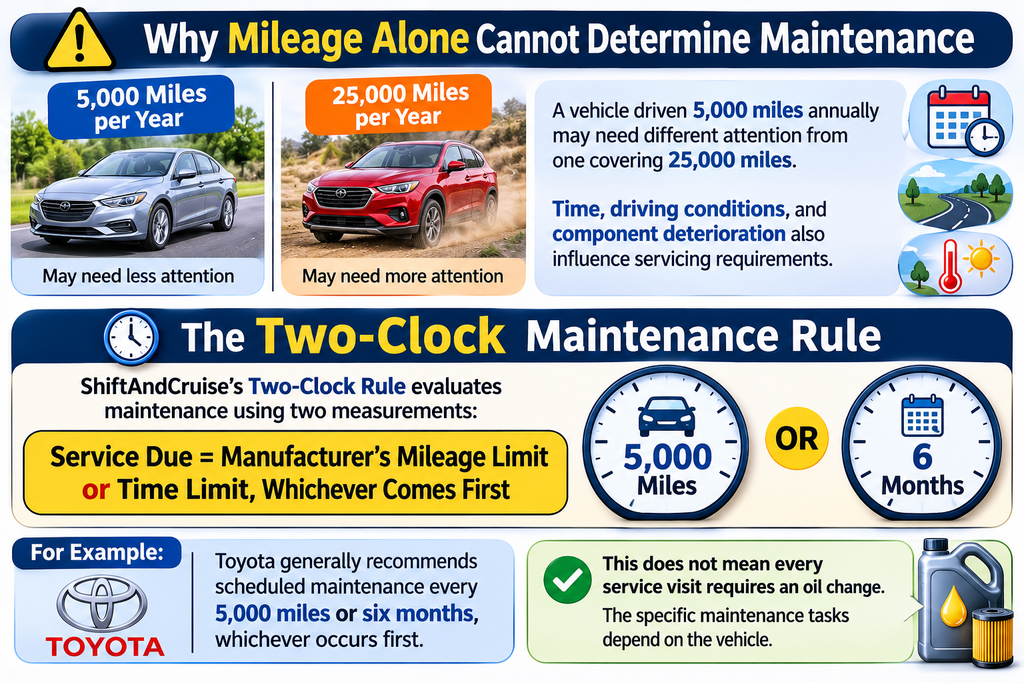
A vehicle driven 5,000 miles annually may need different attention from one covering 25,000 miles.
Time, driving conditions, and component deterioration also influence servicing requirements.
The Two-Clock Maintenance Rule
ShiftAndCruise’s Two-Clock Rule evaluates maintenance using two measurements:
Service Due = Manufacturer’s Mileage Limit or Time Limit, Whichever Comes First
For example, Toyota generally recommends scheduled maintenance every 5,000 miles or six months, whichever occurs first.
This does not mean every service visit requires an oil change. The specific maintenance tasks depend on the vehicle.
Monthly Maintenance Checklist
Even when your vehicle has not reached its next mileage milestone, inspect:
- Tire pressure and visible tire damage.
- Engine oil and other accessible fluid levels.
- Exterior lights and windshield wipers.
- Visible leaks beneath the vehicle.
- Unusual noises or dashboard warnings.
The National Highway Traffic Safety Administration recommends checking tire pressure at least monthly using the manufacturer’s recommended cold inflation pressure.
Severe Driving Conditions
Some driving environments require shorter service intervals.
Examples include frequent short trips, heavy traffic, dusty roads, towing, and prolonged idling.
Follow the severe-service schedule when your driving conditions meet the manufacturer’s definition.
Maintenance Reminder Systems
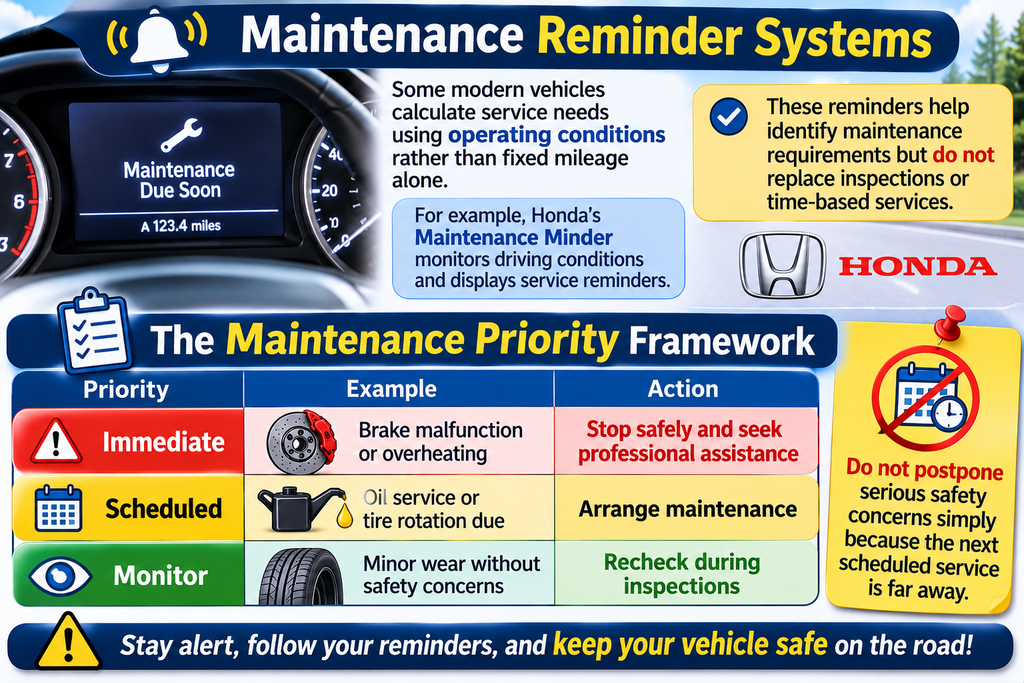
Some modern vehicles calculate service needs using operating conditions rather than fixed mileage alone.
For example, Honda’s Maintenance Minder monitors driving conditions and displays service reminders.
These reminders help identify maintenance requirements but do not replace inspections or time-based services.
The Maintenance Priority Framework
| Priority | Example | Action |
|---|---|---|
| Immediate | Brake malfunction or overheating | Stop safely and seek professional assistance |
| Scheduled | Oil service or tire rotation due | Arrange maintenance |
| Monitor | Minor wear without safety concerns | Recheck during inspections |
Do not postpone serious safety concerns simply because the next scheduled service is several thousand miles away.
How to Track Maintenance and Avoid Unnecessary Repairs
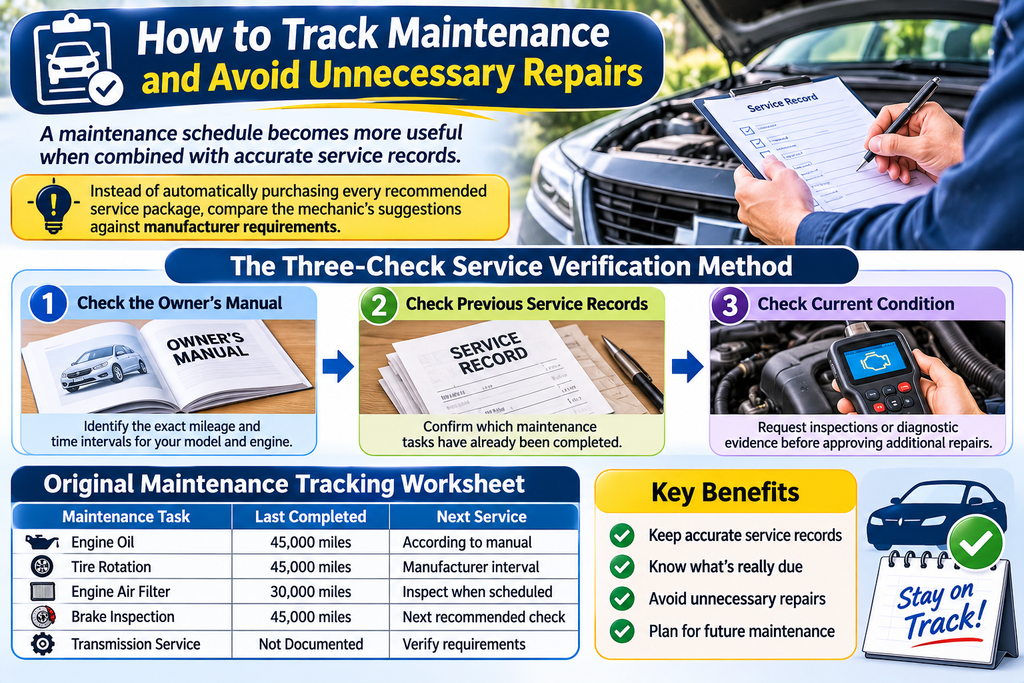
A maintenance schedule becomes more useful when combined with accurate service records.
Instead of automatically purchasing every recommended service package, compare the mechanic’s suggestions against manufacturer requirements.
The Three-Check Service Verification Method
Check the owner’s manual: Identify the exact mileage and time intervals for your model and engine.
Check previous service records: Confirm which maintenance tasks have already been completed.
Check current condition: Request inspections or diagnostic evidence before approving additional repairs.
This approach can help distinguish necessary maintenance from services that are not yet due.
Original Maintenance Tracking Worksheet
| Maintenance task | Last completed | Next service |
|---|---|---|
| Engine oil | 45,000 miles | According to manual |
| Tire rotation | 45,000 miles | Manufacturer interval |
| Engine air filter | 30,000 miles | Inspect when scheduled |
| Brake inspection | 45,000 miles | Next recommended check |
| Transmission service | Not documented | Verify requirements |
These entries are illustrative. Actual due dates must come from the vehicle-specific schedule.
Recording service dates, mileage, receipts, and inspection findings makes it easier to plan future maintenance.
Maintenance for High-Mileage Used Cars
If you purchase a vehicle with 100,000 miles or more, establish its maintenance history before assuming every milestone service is overdue.
Review previous oil changes, transmission servicing, coolant replacement, and major repairs.
An independent mechanic can help identify outstanding work and prioritize safety-related problems.
Hybrid and electric vehicles require additional considerations. Battery cooling systems, regenerative braking, and high-voltage components may have specific inspection procedures.
Never attempt high-voltage repairs without appropriate professional training.
How to Reduce Maintenance Expenses
Follow manufacturer recommendations, compare written repair estimates, and avoid unnecessary fluid flushes or replacement services.
Consider combining compatible routine services during one appointment to reduce inconvenience.
Preventive maintenance cannot eliminate all repairs, but documented servicing can support vehicle reliability and future resale value.
Final Takeaway: Maintain Your Car at the Right Intervals
The most effective maintenance plan combines mileage checkpoints, time-based requirements, and regular vehicle inspections.
Routine servicing commonly occurs every 5,000–10,000 miles, while more extensive maintenance may be needed as your vehicle approaches 30,000, 60,000, and 100,000 miles.
Always consult your manufacturer’s schedule and keep accurate service records.
The goal isn’t to service your car more often than necessary. It’s to complete the right maintenance at the right time to support safety, reliability, and long-term ownership value.