
Your car starts normally every morning—until one day, you turn the key or press the start button and hear nothing but a click. A dead battery can leave you stranded without much warning, especially when the battery is getting older.
So, what is the average car battery lifetime, and how do you know when yours needs replacing?
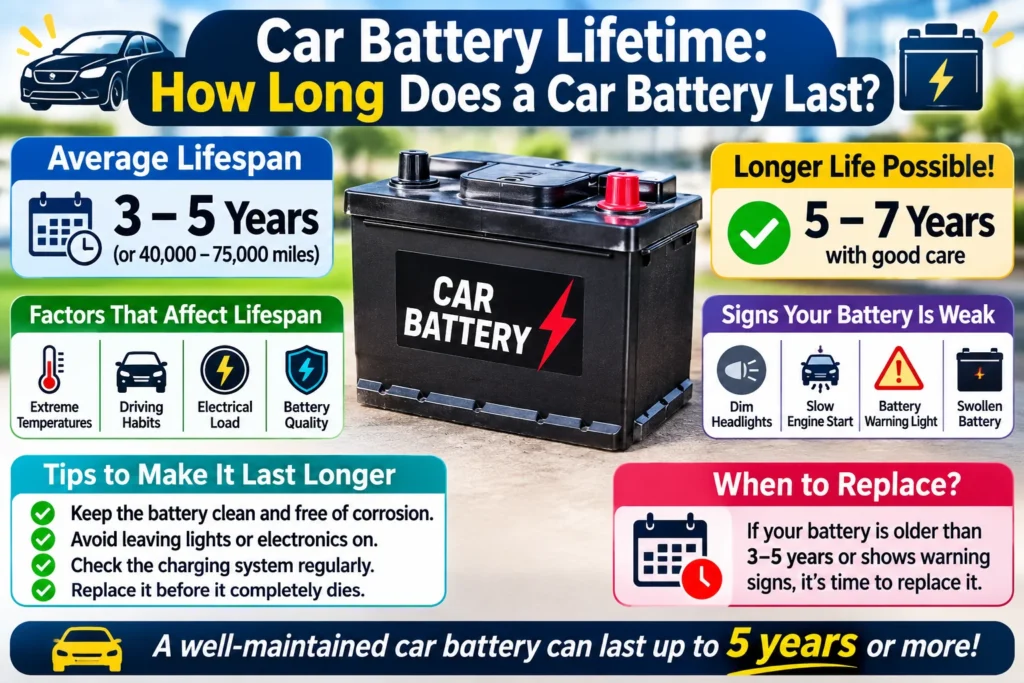
Quick answer: Most conventional 12-volt car batteries last approximately 3 to 5 years, although actual lifespan depends on temperature, driving habits, battery type, and vehicle maintenance. Batteries exposed to extreme heat or frequent short trips may fail sooner.
This guide explains how long car batteries last, what shortens their lifespan, how to recognize warning signs, and when replacement makes more sense than recharging.
How Long Does a Car Battery Last?
The average car battery lifespan is approximately 3–5 years, according to AAA and Interstate Batteries.
However, this range is not a guaranteed replacement schedule. Some batteries fail after two years, while others continue functioning beyond five years.
Climate is particularly important. AAA notes that batteries in cooler northern regions may last five years or longer, while batteries in hot southern climates often last closer to three years.
Average Car Battery Life by Condition
| Driving conditions | What to expect |
|---|---|
| Moderate climate and regular driving | Often 3–5 years |
| Hot southern climate | Often closer to 3 years |
| Cooler climate | May reach 5 years or longer |
| Frequent short trips | Potentially shorter lifespan |
| Long periods without driving | Increased risk of discharge and deterioration |
These are general expectations, not precise predictions for individual vehicles.
Helpful rule: Once your battery reaches three years of age, regular testing becomes increasingly important.
What Affects Car Battery Lifetime?
Several factors determine how quickly a battery loses its ability to start your engine.
1. Extreme Heat
Hot weather is one of the biggest enemies of automotive batteries.
Heat accelerates internal chemical deterioration and can increase water loss in certain lead-acid batteries.
Drivers in states such as Arizona, Texas, and Florida may experience shorter battery life because of prolonged summer temperatures.
2. Cold Weather
Cold temperatures reduce a battery’s available starting power.
At the same time, engines can require more effort to start in freezing conditions.
A battery weakened by summer heat may therefore fail during the first major winter cold spell.
3. Frequent Short Trips
Starting a vehicle consumes electrical energy.
During driving, the charging system replenishes that energy, but repeated short trips may not allow sufficient recovery.
Drivers who regularly travel only a few miles at a time may experience premature battery deterioration.
4. Leaving the Car Parked
A parked vehicle continues drawing small amounts of power for functions such as security systems, computers, and memory settings.
Over time, this can discharge the battery.
Repeated deep discharges can permanently reduce the service life of a conventional lead-acid battery.
5. Battery Vibration and Poor Connections
A loose battery can experience excessive vibration, potentially damaging internal components.
Corroded or loose terminals can also interfere with reliable starting and charging.
Keeping the battery securely mounted and its connections in good condition helps prevent avoidable problems.
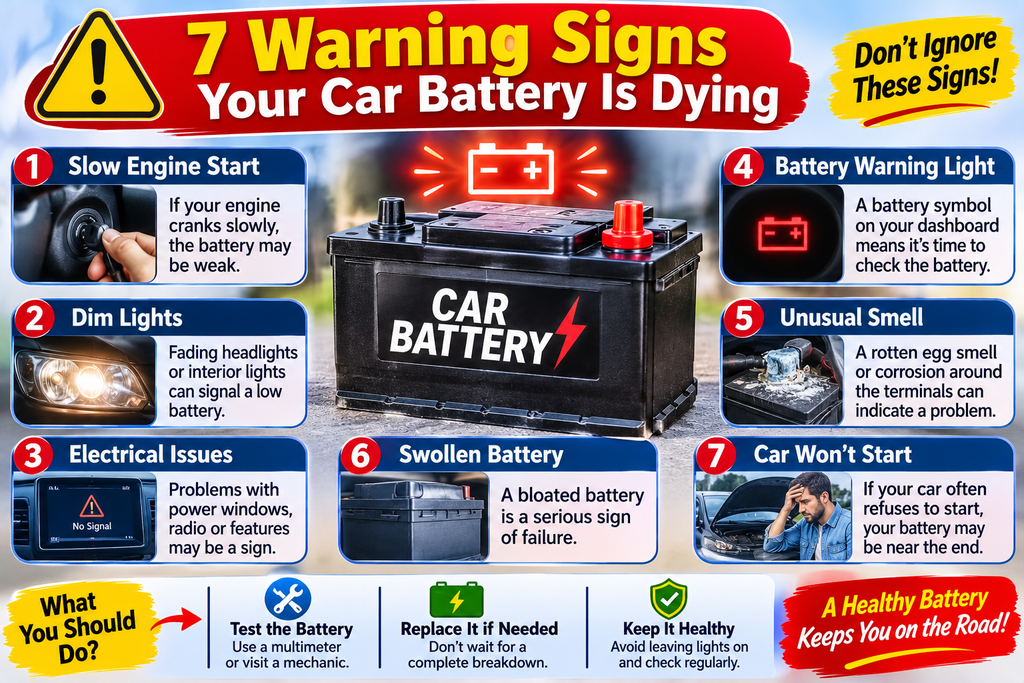
7 Warning Signs Your Car Battery Is Dying
Recognizing early symptoms can help you avoid an unexpected breakdown.
1. Slow Engine Cranking
If the engine turns over more slowly than normal, the battery may be losing its ability to deliver sufficient starting current.
2. Clicking When Starting
A rapid clicking sound can indicate inadequate battery power, although starter or connection problems may produce similar symptoms.
3. Dim Headlights
Headlights that appear unusually dim, especially with the engine off, may indicate a weak battery.
4. Frequent Jump-Starts
A battery that repeatedly needs jump-starting deserves immediate testing.
The problem may involve the battery itself, the charging system, or an excessive electrical drain.
5. Visible Terminal Corrosion
White, green, or bluish deposits around battery terminals can interfere with electrical connections.
6. Swollen or Damaged Battery Case
A swollen, cracked, or leaking battery can indicate serious damage.
Do not attempt to charge or jump-start a visibly damaged battery. Arrange professional assistance.
7. Dashboard Battery Warning Light
A battery-shaped dashboard warning light may indicate a charging-system problem rather than a worn-out battery alone.
If the light remains illuminated while driving, have the vehicle checked promptly.
How to Check Your Car Battery’s Health

You do not need to wait until your vehicle refuses to start.
A battery inspection and proper test can help identify problems earlier.
Check the Battery’s Age
Look for a manufacturing date sticker or date code on the battery case.
Some batteries also have an installation label.
Remember that a manufacturing date is not necessarily the same as the installation date.
Measure Battery Voltage
For a conventional 12-volt lead-acid battery, a basic voltage check can provide an initial indication of its state of charge.
| Resting voltage | General interpretation |
|---|---|
| Around 12.6–12.8V | Usually well charged |
| Around 12.4V | Partially charged |
| Around 12.2V | Significantly discharged |
| Around 12.0V or lower | Very low charge |
Measure after the battery has rested, with the engine and electrical accessories off. These values are approximate and temperature-dependent.
Important: Voltage alone cannot determine whether a battery is healthy. A weak battery may show normal resting voltage but fail under starting load.
Get a Professional Battery Test
A technician can evaluate battery condition using a conductance tester or load test.
A proper diagnosis may also involve checking charging-system performance and unwanted electrical drains.
Consumer Reports recommends annual load testing once a battery is approximately two years old in warmer climates or four years old in colder climates.
How to Make Your Car Battery Last Longer
Simple maintenance practices can help extend battery life.
- Avoid unnecessary short trips: Combine errands when possible to allow adequate charging.
- Keep terminals clean: Have corrosion addressed safely and ensure connections are secure.
- Secure the battery: Make sure the proper mounting hardware is installed.
- Limit unnecessary electrical loads: Turn off accessories when the engine is not running.
- Protect against excessive heat: Use available covered parking and retain factory-installed heat shields.
- Use a battery maintainer: For extended storage, consider a compatible smart maintainer following the vehicle manufacturer’s instructions.
- Check your charging system: Investigate repeated battery discharge rather than automatically purchasing another battery.
Avoid disconnecting or handling battery terminals without following the manufacturer’s safety procedures. Batteries can release flammable gas and contain corrosive electrolyte.
How Long Do Different Types of Car Batteries Last?
Not every vehicle uses the same 12-volt battery technology.
| Battery type | Lifespan considerations |
|---|---|
| Flooded lead-acid | Commonly lasts around 3–5 years |
| AGM battery | May last longer under suitable conditions |
| Enhanced flooded battery (EFB) | Designed for higher cycling demands |
| Hybrid vehicle 12V battery | Varies by model and battery chemistry |
| EV high-voltage battery | Different technology and lifespan expectations |
AGM batteries are often used in vehicles with advanced electrical demands and start-stop systems.
However, upgrading to an AGM battery is not automatically appropriate for every vehicle.
Always match the replacement battery to the manufacturer’s specified battery type, size, cold-cranking amps, and charging requirements.
How Much Does It Cost to Replace a Car Battery?
Battery replacement cost depends on the vehicle, battery technology, and installation requirements.
As a broad US shopping reference, conventional replacement batteries may cost roughly $160–$300, with some AGM and specialized applications costing more.
Additional costs may include labor, testing, battery registration, taxes, and a refundable core charge where applicable.
Before buying, confirm that the replacement meets your vehicle’s specifications.
A cheaper but incompatible battery may create starting or charging problems.
When Should You Replace Your Car Battery?
A three-year-old battery does not necessarily need immediate replacement.
However, it should be monitored more closely.
Consider replacing your battery when:
- It repeatedly fails a professional battery test.
- It struggles to hold a charge despite a properly functioning charging system.
- It requires frequent jump-starts.
- Its case is damaged or swollen.
- It is older and showing multiple signs of deterioration.
If the battery continues passing tests and the vehicle starts reliably, replacement may not yet be necessary.
For a high-mileage road trip or travel through remote areas, preventive replacement may be reasonable when an aging battery tests marginally.
Frequently Asked Questions
Can a Car Battery Last 10 Years?
Yes, some car batteries last 10 years or longer, but that is unusual compared with the commonly expected 3–5-year lifespan.
How Long Does a Car Battery Last Without Driving?
It varies depending on battery condition, temperature, and electrical consumption. Some cars may start after several weeks, while others develop starting problems sooner.
Does Driving Recharge a Car Battery?
Yes. A properly functioning charging system replenishes battery energy while the engine is running. However, short trips may not fully recharge a significantly discharged battery.
Can a Bad Alternator Damage a New Battery?
Yes. An alternator or charging-system fault can cause repeated undercharging or overcharging, potentially shortening battery life.
Is It Better to Recharge or Replace a Car Battery?
Recharge a healthy battery that has become discharged. Replace one that fails testing, cannot hold a charge, or has unsafe physical damage. Diagnose the underlying cause if the battery repeatedly goes flat.
Final Verdict
The typical car battery lifetime is 3 to 5 years, but temperature, maintenance, driving habits, and electrical demands all affect how long a battery remains dependable.
Rather than replacing batteries solely by age, combine regular testing with careful attention to warning signs.
If your battery is approaching three years old, especially in a hot climate, schedule a professional health check.
A little preventive maintenance can help avoid unexpected starting problems and keep your vehicle ready for everyday driving.