
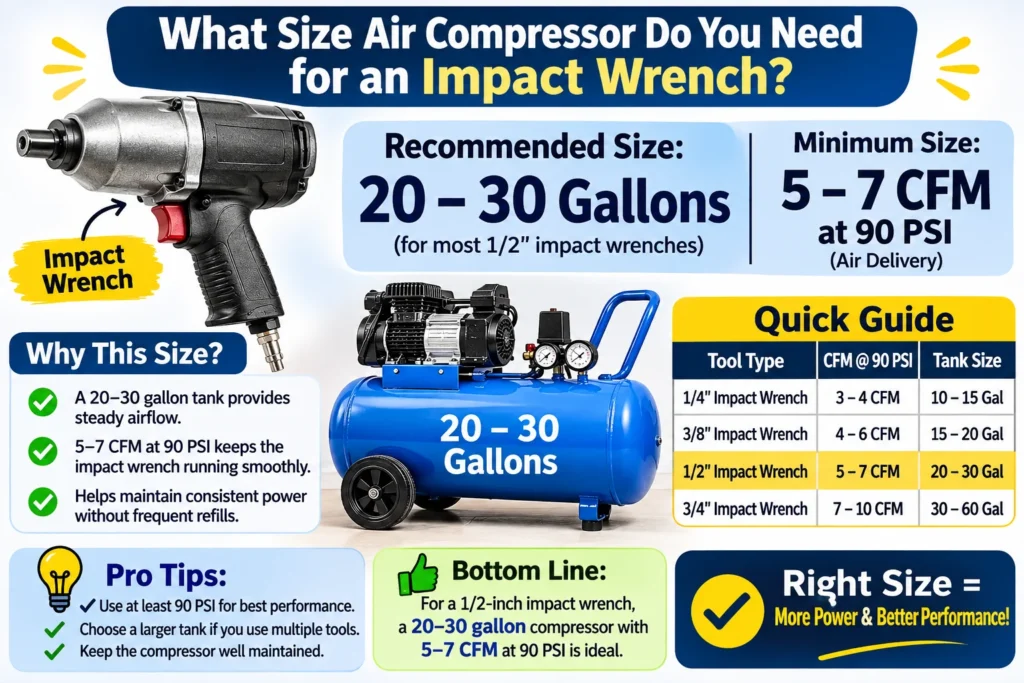
Choosing the right air compressor for an air impact wrench can make the difference between removing stubborn lug nuts efficiently and constantly waiting for your compressor to refill.
If you’re setting up a home garage, you might wonder whether a 6-gallon compressor is enough or whether you need a larger 20-gallon or 30-gallon unit.
Quick answer: Many 1/2-inch pneumatic impact wrenches operate at approximately 90 PSI and publish average air consumption figures around 4–6 CFM. However, their actual airflow demand under load can exceed 20 CFM. For occasional automotive work, a compressor with suitable airflow and enough air storage may work well. For frequent use, a higher-output compressor is preferable.
The important point is that tank size alone does not determine whether a compressor can run an impact wrench.
This guide explains CFM, PSI, tank capacity, and how to choose the right compressor for your garage.
How Much Air Does an Impact Wrench Need?
An air impact wrench uses compressed air to power an internal impact mechanism that loosens and tightens fasteners.
Unlike an electric impact wrench, a pneumatic model depends on an external air supply.
Two specifications determine whether your compressor is suitable:
- CFM (cubic feet per minute): Measures airflow consumption or delivery.
- PSI (pounds per square inch): Measures air pressure.
Most common automotive impact wrenches are rated around 90 PSI, but their airflow requirements differ significantly.
Air Impact Wrench CFM Requirements
| Impact wrench | Air consumption guidance |
|---|---|
| 3/8-inch impact wrench | Check model specifications; often intended for lighter tasks |
| 1/2-inch impact wrench | Example: 4.2 CFM average and 22 CFM under load |
| 3/4-inch impact wrench | Often demands more air; verify the exact model |
| 1-inch impact wrench | Usually requires a substantial high-output air supply |
The 1/2-inch example comes from the Ingersoll Rand 231C. These figures should not be treated as universal ratings for every impact wrench.
Smaller drive sizes do not always guarantee lower airflow requirements. Tool design and operating conditions matter.
CFM vs. PSI: What Matters More?
Both specifications matter, but they perform different functions.
Understanding PSI
PSI tells you the pressure available to operate the wrench.
If an impact wrench requires 90 PSI, the compressor and regulator must deliver the specified pressure while the tool is operating.
A compressor advertised with a maximum pressure of 150 PSI does not automatically provide sufficient airflow.
Understanding CFM
CFM measures how much air the compressor can deliver over time.
For example, suppose your impact wrench consumes an average of 5 CFM during intermittent use.
If your compressor delivers only 2.5 SCFM at 90 PSI, the tool may run briefly using stored air, but the tank can lose pressure faster than the compressor replenishes it.
Buying tip: Compare the compressor’s delivered SCFM at 90 PSI with your impact wrench’s published air-consumption specifications.
Do not confuse an impact wrench’s average consumption with its consumption under continuous load.
What Size Air Compressor Is Best for a 1/2-Inch Impact Wrench?

A 1/2-inch impact wrench is one of the most common tools used for automotive repairs.
It is useful for removing wheel lug nuts and working on suspension components when the tool and fastener specifications are appropriate.
However, two 1/2-inch impact wrenches can require very different amounts of air.
For example, the Ingersoll Rand 231C has these published specifications:
| Specification | Value |
|---|---|
| Drive size | 1/2 inch |
| Recommended operating pressure | 90 PSI |
| Average air consumption | 4.2 CFM |
| Air consumption under load | 22 CFM |
| Minimum hose inside diameter | 3/8 inch |
For occasional short bursts, a compressor supplying around 5–6 SCFM at 90 PSI may be a practical starting point for some tools with similar average consumption.
For sustained operation, you need to evaluate the much higher loaded airflow demand.
A compressor with greater delivery capacity will recover more quickly and reduce interruptions.
Can a 6-Gallon Air Compressor Run an Impact Wrench?
Yes, some 6-gallon air compressors can run an impact wrench for short bursts, but that does not mean every 6-gallon compressor is suitable.
A small portable compressor may have enough stored air to loosen one or two fasteners before its pressure drops.
If the compressor delivers substantially less air than the wrench consumes, you may experience:
- Frequent compressor cycling
- Reduced tool performance as pressure falls
- Longer waiting periods
- Difficulty with repeated or stubborn fasteners
When a 6-Gallon Compressor Makes Sense
A small compressor may be sufficient for occasional light-duty work, provided it meets the wrench’s operating requirements.
However, it is generally less convenient for extended tire changes or frequent automotive repairs.
Always compare actual SCFM ratings. Two compressors with identical 6-gallon tanks may have very different performance.
Is a 20-Gallon Air Compressor Enough for an Impact Wrench?
For many home mechanics, a 20-gallon compressor offers a useful balance between storage capacity, portability, and garage convenience.
Compared with a 6-gallon unit, a larger tank stores more compressed air at the same pressure.
This can support longer bursts of tool use before the compressor needs to replenish the tank.
However, a larger tank does not increase the pump’s continuous airflow output.
A 20-gallon compressor delivering 4 SCFM at 90 PSI may still struggle with frequent operation of a demanding impact wrench.
6-Gallon vs. 20-Gallon vs. 30-Gallon Compressor
| Tank capacity | Practical use |
|---|---|
| 6 gallons | Short, occasional bursts with a compatible wrench |
| 20 gallons | Intermittent home-garage automotive work |
| 30 gallons | Longer work sessions when paired with sufficient pump output |
| 60 gallons or more | Potentially suitable for demanding shop use, depending on airflow ratings |
These are general use cases, not guaranteed compatibility ratings.
A high-output small-tank compressor can outperform a low-output large-tank model during repeated operation.
How to Match Your Compressor to Your Impact Wrench
Rather than guessing based on gallons, use this five-step process.
Step 1: Check Your Impact Wrench Specifications
Find the manufacturer’s air-consumption rating.
Pay attention to whether the number describes average use, free-speed operation, or consumption under load.
Step 2: Confirm the Required PSI
Most common automotive impact wrenches specify approximately 90 PSI.
Use the exact pressure stated by the manufacturer.
Step 3: Compare Compressor Output
Find the compressor’s delivered SCFM rating at the tool’s specified pressure.
For intermittent work, consider average consumption alongside tank storage and recovery time.
For frequent or sustained work, check loaded consumption and compressor duty cycle.
Step 4: Allow Some Extra Capacity
Avoid choosing a compressor that barely meets your intended average demand.
A reasonable starting point for system planning is an additional 15–25% airflow allowance for pressure losses, leakage, and future needs.
Step 5: Check Your Hose and Fittings
An undersized hose, restrictive fittings, or excessive hose length can cause pressure drops.
Follow the impact wrench manufacturer’s minimum hose diameter and air-inlet recommendations.
Air Compressor Sizing Calculator
Use this simple estimate to plan airflow capacity for intermittent use.
Estimated airflow = Average tool CFM × 1.20
For example:
- Average tool consumption: 5 CFM
- Planning allowance: 20%
- Estimated compressor delivery: 6 SCFM at the specified operating pressure
This is a preliminary sizing estimate, not a guarantee of continuous tool performance.
If the wrench has a much higher loaded airflow requirement, tank storage and short operating bursts may temporarily cover the difference. Continuous use may require a considerably larger compressor.
Best Air Compressor Features for Automotive Work
When shopping for a compressor, consider more than tank size and advertised maximum PSI.
Delivered SCFM at 90 PSI
This is one of the most useful specifications for matching an automotive impact wrench.
Compressor Duty Cycle
Duty cycle indicates how long a compressor can operate within its specified operating limits.
Frequent automotive work may require a compressor designed for longer running periods.
Oil-Free vs. Oil-Lubricated Pumps
Oil-free compressors can be convenient for occasional home use.
Oil-lubricated models are also available and may suit demanding applications, depending on their design and maintenance requirements.
Neither pump type automatically guarantees better airflow.
Noise and Electrical Requirements
Check the compressor’s noise rating and electrical supply requirements.
Larger compressors may require dedicated circuits or higher-voltage connections.
Air Hose Compatibility
Choose the hose size recommended for your impact wrench, and use fittings designed for the required airflow and pressure.
Common Air Compressor Buying Mistakes
Avoid these common errors when choosing pneumatic garage equipment.
Buying based only on gallons: Tank capacity tells you how much air can be stored, not how quickly it can be replenished.
Ignoring airflow ratings: A compressor with high maximum PSI may still deliver insufficient SCFM.
Comparing different consumption figures: Average airflow and loaded airflow are not interchangeable.
Using restrictive hoses: Small hoses or fittings can reduce pressure at the wrench.
Ignoring duty cycle: Repeated operation beyond the manufacturer’s limits may lead to overheating and accelerated equipment wear.
Using excessive pressure: Operating beyond the tool manufacturer’s recommended pressure can create safety hazards and damage equipment.
Frequently Asked Questions
What Size Air Compressor Do I Need for a 1/2-Inch Impact Wrench?
Many 1/2-inch impact wrenches specify around 90 PSI, but airflow requirements vary. Check the model’s average and loaded CFM ratings before selecting a compressor.
Will a 6-Gallon Air Compressor Remove Lug Nuts?
It may remove lug nuts in short bursts if the tool receives adequate pressure and airflow. Performance depends on the compressor, wrench, and fastener condition.
Is a 20-Gallon Compressor Better Than a 6-Gallon Compressor?
A 20-gallon tank provides greater air storage at the same pressure, but continuous performance still depends on delivered SCFM and pump capacity.
Can I Use a 150 PSI Compressor With a 90 PSI Impact Wrench?
Yes, provided the compressor has a suitable regulator and sufficient airflow. Set the operating pressure according to the tool manufacturer’s instructions.
Do I Need an Air Compressor for a Cordless Impact Wrench?
No. Cordless electric impact wrenches operate using rechargeable batteries rather than compressed air.
Final Verdict
The best air compressor for an air impact wrench depends on the specific tool’s airflow requirements and how frequently you plan to use it.
A 6-gallon compressor may be adequate for occasional short bursts, while a 20-gallon or 30-gallon model can offer greater air storage for home-garage work.
For frequent automotive repairs, prioritize delivered SCFM, operating pressure, recovery performance, and duty cycle over tank capacity alone.
Before purchasing, match the compressor to the wrench manufacturer’s specifications and allow enough capacity for your intended workload.
A properly matched air system will make garage work more efficient, reduce waiting time, and help your impact wrench perform as designed.