
Imagine driving along a quiet-looking desert highway, with red sandstone mountains rising in the distance and an endless stretch of road leading straight toward them. It is one of the most recognizable views in the American Southwest—and you may have already seen it in the movie Forrest Gump. Forrest Gump Point is a famous roadside viewpoint along US Highway 163 in southeastern Utah, just north of Monument Valley. Travelers visit this scenic stretch of highway for its cinematic history, beautiful desert scenery, and unforgettable photography opportunities.
But before planning your visit, there are a few important things to know. This is an active highway, not a designated pedestrian attraction. Understanding where to stop, how to take photographs safely, and which direction to travel can make a big difference.
This guide covers everything you need to know about visiting Forrest Gump Point, including its exact location, directions, parking, the best photography times, safety tips, and nearby road trip attractions.
Forrest Gump Point: Quick Visitor Information
| Visitor Information | Details |
|---|---|
| Location | US Highway 163, near Mexican Hat, Utah |
| GPS Coordinates | 37.101445, -109.990812 |
| Nearest Major Attraction | Monument Valley Navajo Tribal Park |
| Nearest Town | Mexican Hat, Utah |
| Entrance Fee | Free for the public highway viewpoint |
| Recommended Visit Duration | Approximately 15–30 minutes |
| Best Photography Time | Morning to early afternoon |
| Main Attraction | Famous Forrest Gump movie location and Monument Valley scenery |
| Parking | Roadside pull-offs where stopping is permitted and safe |
| Restrooms | No dedicated public restrooms at the viewpoint |
Travel advisory — November 2026: Severe flooding damaged the Comb Wash bridge on US-163 between Bluff and Mexican Hat, interrupting the usual route from the north. The road’s current reopening status has not been independently confirmed for this guide.
What Is Forrest Gump Point in Utah?
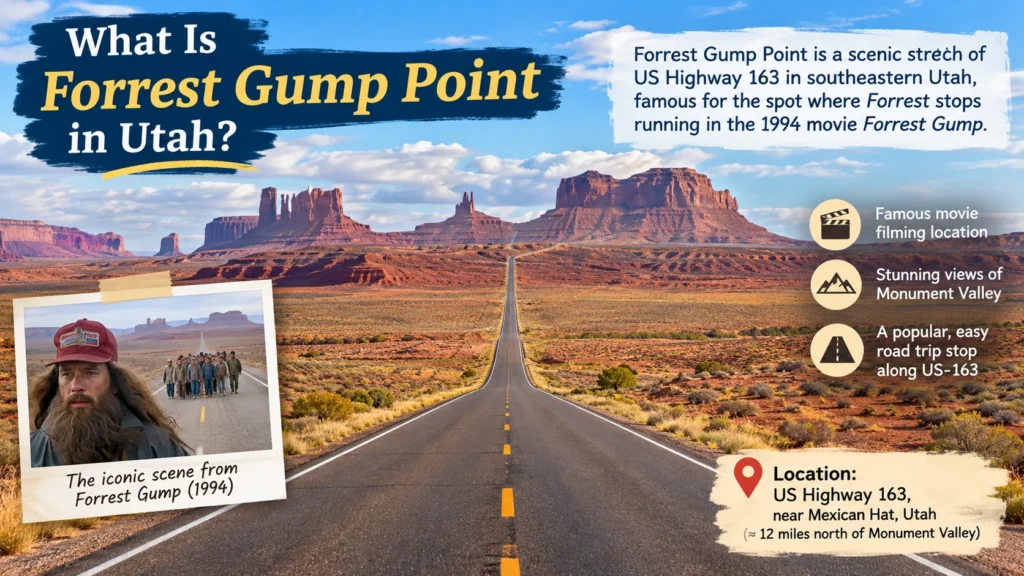
Forrest Gump Point is a scenic location on US Highway 163, famous for appearing in the 1994 movie Forrest Gump, starring Tom Hanks. In the movie, Forrest spends more than three years running across America. Eventually, he reaches a stretch of desert highway with Monument Valley’s distinctive rock formations behind him and unexpectedly decides to stop running. The scene became one of the movie’s most memorable moments. Today, travelers recognize the location by its long, straight highway, rolling desert landscape, and distant sandstone buttes.
Although it is commonly called Forrest Gump Point, or sometimes Forrest Gump Hill, it is not a conventional tourist attraction with a visitor center, walking paths, or a large parking lot. It is simply a scenic stretch of road that became internationally famous. The area is also part of the broader Navajo Nation landscape, which has cultural and historical importance extending far beyond its Hollywood connection. Even if you have never watched the movie, the scenery makes this location an appealing stop during a Utah or Arizona road trip.
Where Is Forrest Gump Point Located?
Forrest Gump Point is located in San Juan County, southeastern Utah, along US Highway 163 near mile marker 13. The viewpoint sits between the small community of Mexican Hat and Monument Valley, close to the Utah–Arizona border.
Exact GPS coordinates: 37.101445, -109.990812
View Forrest Gump Point on Google Maps
The famous photograph looks south toward Monument Valley. From the viewpoint area, US-163 stretches across the desert before climbing toward the towering sandstone formations in the distance.
The location is approximately:
- 12–13 miles south of Mexican Hat, Utah.
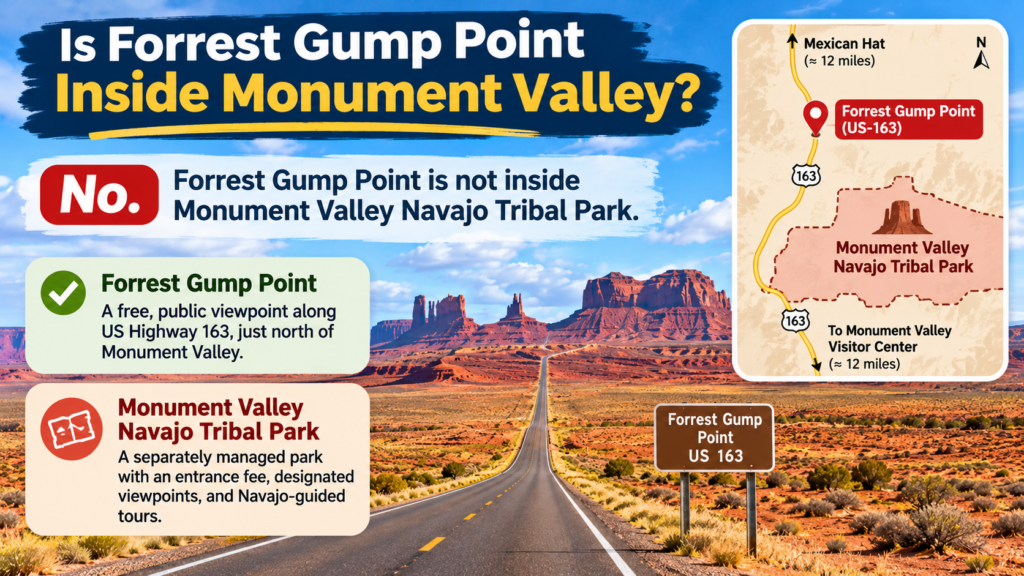
- 12 miles north of the Monument Valley Navajo Tribal Park visitor center area.
- Around 15–20 minutes by car from the Monument Valley visitor center in normal driving conditions.
Travel distances and times are approximate and assume the roads are open.
Is Forrest Gump Point Inside Monument Valley?
Forrest Gump Point overlooks Monument Valley, but it is not inside the paid scenic driving area of Monument Valley Navajo Tribal Park. This distinction is important. You can enjoy the famous highway view without purchasing admission to the Tribal Park. However, entering the park to visit its designated viewpoints, drive its scenic loop when open, or join a Navajo-guided tour involves separate visitor regulations and fees.
How to Get to Forrest Gump Point
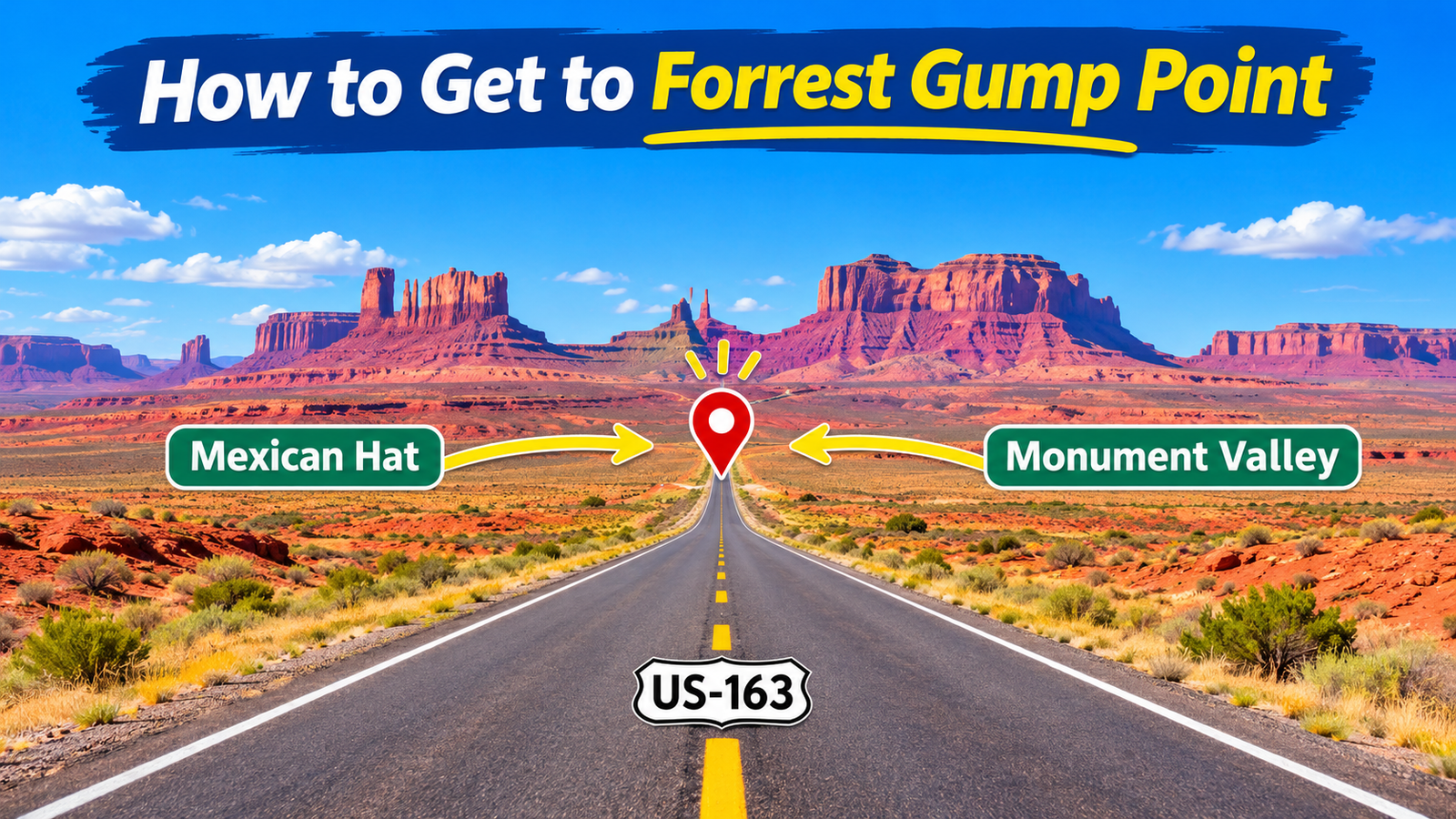
Reaching Forrest Gump Point is normally straightforward because it lies directly along US-163. However, the best route depends on where your road trip begins and whether any highway closures affect the area.
From Monument Valley
If you are visiting Monument Valley Navajo Tribal Park, you can normally reach Forrest Gump Point by heading north along US-163. The journey takes approximately 15–20 minutes in ordinary conditions. As you travel north, the famous view will be behind you, looking south toward the valley. Continue to a lawful place to turn around or stop rather than making a sudden maneuver on the highway. This short excursion is particularly convenient for travelers exploring Monument Valley before continuing north toward Mexican Hat.
From Mexican Hat, Utah
Mexican Hat is one of the nearest communities to Forrest Gump Point. Under normal conditions, the viewpoint is approximately 12–13 miles south of town along US Highway 163. Follow the highway toward Monument Valley and watch for the scenic landscape around mile marker 13. Avoid sudden braking, stopping in the driving lane, or making an unsafe U-turn if you miss the location.
From Moab or Bluff, Utah
Travelers coming from Moab and Bluff would ordinarily approach the Monument Valley region using US-191 and US-163. However, flooding in November 2026 washed out the Comb Wash bridge on US-163 between Bluff and Mexican Hat. As a result, the normal route may be unavailable until repairs and reopening are confirmed.
Do not rely on an older navigation route without checking official travel advisories. Follow posted detours and never attempt to bypass barricades or drive through floodwater.
Navigation tip: Save the GPS coordinates and download an offline map before leaving an area with reliable mobile service. Cell coverage may be inconsistent in remote parts of the Southwest.
Where to Park at Forrest Gump Point
Parking is one of the most important things to understand before visiting Forrest Gump Point. Unlike a developed scenic overlook, this location is along an active two-lane highway. Some visitors use roadside pull-offs, but there is no guarantee that a suitable stopping space will be available. When approaching the area, look carefully for a lawful pull-off with enough room to position your vehicle completely outside the travel lanes.Do not park on the roadway, block the shoulder, obstruct another vehicle’s visibility, or stop near a blind hill or curve.
If you cannot find a suitable place to stop, continue driving and enjoy the view from your vehicle. A photograph is never worth putting yourself or another road user at risk.
Families should be especially careful when exiting vehicles. Keep children close and away from the roadway at all times.
Important: Never stand, sit, pose, or set up a camera in an active traffic lane. The famous road-centered photograph is not a safe reason to enter moving traffic.
Best Time to Visit Forrest Gump Point
The best time to photograph Forrest Gump Point is generally in the morning, when sunlight illuminates the distant sandstone formations. The landscape looks different throughout the day as the position of the sun changes.
Early Morning
Morning is often the best choice for visitors who want clear details and rich colors in their landscape photographs. Sunlight reaches the formations ahead, making the red and orange tones more visible. Earlier visits may also offer a quieter atmosphere, although traffic and crowd levels are never guaranteed.
Midday and Early Afternoon
Midday offers strong daylight, which can help capture the wide desert landscape and distant rock formations. However, intense overhead sunlight may produce harsh shadows, particularly during summer. Photographers can compensate by adjusting exposure and avoiding excessively bright areas of sky.
Late Afternoon and Sunset
Sunset can produce beautiful desert colors, but it is not necessarily the best time for the classic Forrest Gump Point photograph. Because the famous view faces generally south toward Monument Valley, the position of the setting sun can create backlighting and glare, depending on the season. The distant formations may appear darker than they do in morning photographs. If you are visiting near sunset, consider capturing silhouettes and dramatic skies rather than expecting the same lighting as the classic daytime photo.
Best Season to Visit
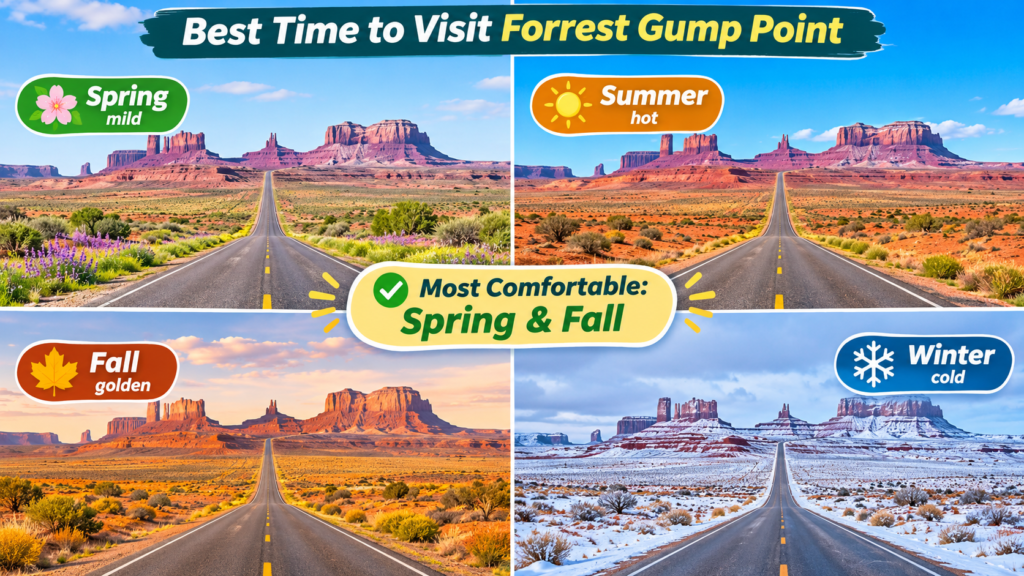
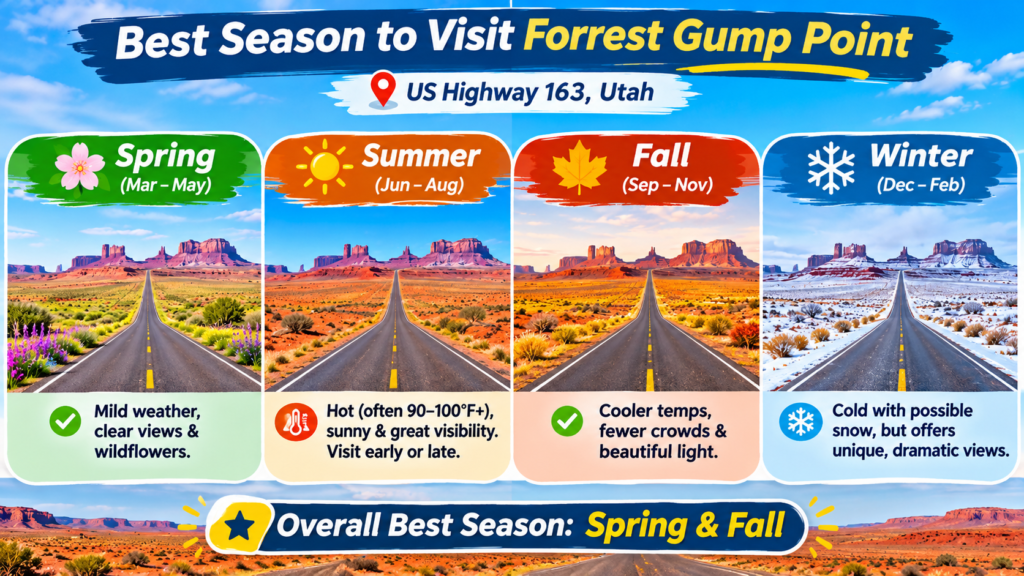
Spring and fall are often comfortable periods for a southeastern Utah road trip. Summer brings longer daylight hours but can also bring extreme heat, strong sunlight, and thunderstorms. Winter may offer beautiful scenery, but cold temperatures and occasional snow or ice can affect driving. Whatever the season, check local forecasts and road conditions before beginning your journey.
How to Take the Best Forrest Gump Point Photos
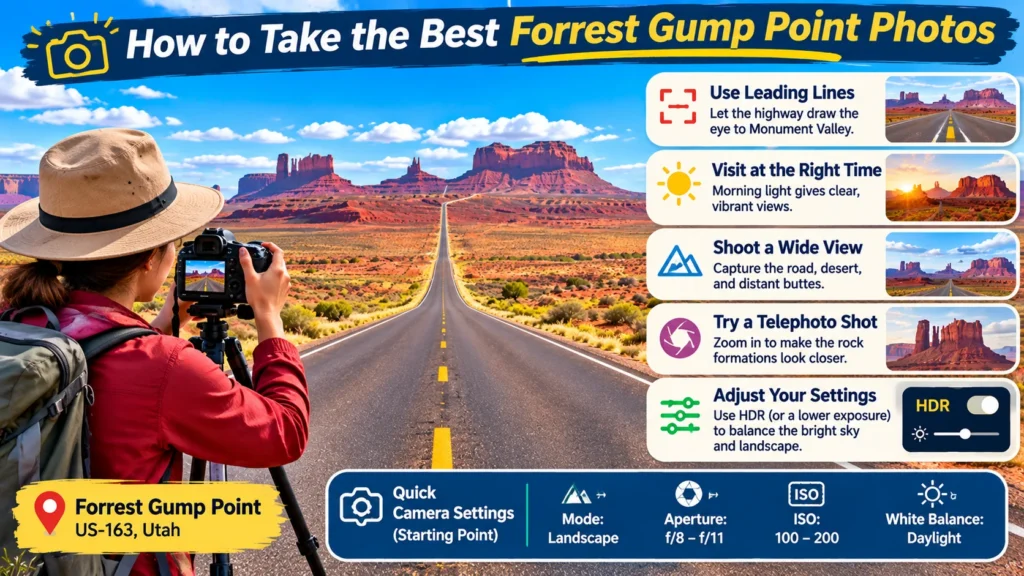
The most recognizable Forrest Gump Point photographs show US-163 stretching toward Monument Valley, with the road creating a strong leading line through the landscape.
You do not need professional camera equipment to capture an impressive photograph. A modern smartphone can produce excellent results with careful composition.
1. Use the Highway as a Leading Line
The highway creates a natural visual path toward the distant rock formations.
From a safe, lawful position outside the travel lanes, frame the road so that the viewer’s eye follows it toward Monument Valley.
Do not step into the road to center the yellow lines. A slightly off-center composition can still capture the dramatic effect.
2. Try a Wide-Angle Photograph
A wide-angle camera setting helps include the open desert, sweeping sky, and distant sandstone buttes. On a smartphone, start with the standard 1x camera and experiment with a wider view when useful. Avoid excessive ultra-wide distortion if it makes the distant formations appear too small.
3. Experiment With a Telephoto Lens
A telephoto lens can make distant rock formations appear larger relative to the landscape. If your phone has an optical 2x or 3x camera, try photographing the view from a safe roadside position. Digital zoom may reduce image quality, especially in low light.
4. Adjust Exposure and Focus
Bright desert skies sometimes cause smartphones to make the land appear too dark. Tap the distant rock formations to focus and adjust exposure until the landscape and sky look balanced. If your camera supports HDR, it can help preserve detail in both bright and shadowed areas.
5. Take Photographs at Different Heights
Small changes in camera height can affect how the road and mountains appear. Experiment with eye-level and slightly lower compositions without approaching traffic or stepping onto unstable ground. The goal is to capture the landscape safely, not to reproduce the movie scene at any cost.
6. Include the Surrounding Desert
While the highway is the famous subject, the surrounding landscape deserves attention too. Wide desert plains, roadside vegetation, distant formations, and changing cloud patterns can produce photographs that feel more personal than a standard recreation of the movie scene.
Photography reminder: Keep yourself and your equipment outside active traffic lanes. If the available roadside position does not provide a safe view, choose a different composition or move on.
Important Road Safety Tips for Visitors
Forrest Gump Point is beautiful, but it also presents real safety risks. US Highway 163 remains an active route used by local drivers, tourists, and commercial vehicles. The Utah tourism authority has warned that dangerous roadway photography at this location has contributed to serious injuries and fatalities.
To reduce the risk:
- Never stand in the middle of the highway to take photographs.
- Pull completely off the road only where stopping is legal and safe.
- Watch for approaching traffic before entering or exiting your vehicle.
- Keep children and pets away from the roadway.
- Avoid sudden turns, unnecessary reversing, or stopping on blind curves.
- Do not operate drones without confirming applicable aviation and Navajo Nation restrictions.
- Leave no trash and respect surrounding Tribal land and private property.
Remember that vehicles may approach faster than expected, and a driver may not see someone standing near a hill or curve until it is too late.
The safest photograph is one taken from a lawful position away from moving traffic.
Is Forrest Gump Point Free to Visit?
Yes. There is no separate admission fee for viewing Forrest Gump Point from the public highway. You do not need to purchase a ticket or book a tour simply to drive past and enjoy the famous scenery.
However, Forrest Gump Point should not be confused with Monument Valley Navajo Tribal Park. The Tribal Park has separate entrance fees, vehicle charges, permitted activities, and operating hours. As listed by Navajo Nation Parks and Recreation in November 2026, the park’s published entrance charges are $10 per person and $15 per vehicle. Fees and access rules may change, so check the official Navajo Nation Parks website before visiting.
Are There Restrooms or Visitor Facilities?
Forrest Gump Point does not have the facilities of a developed tourist attraction.
Do not expect dedicated public restrooms, drinking water, shaded seating, or a staffed information center at the viewpoint.
Plan bathroom breaks and fuel stops before traveling through this remote area. Mexican Hat and the broader Monument Valley region have visitor services, although availability and opening hours vary.
Carry drinking water, sun protection, and suitable clothing for changing weather.
How Much Time Do You Need at Forrest Gump Point?
Most travelers can experience Forrest Gump Point in approximately 15–30 minutes, provided a safe stopping opportunity is available. This is enough time to enjoy the scenery, take a few photographs, and appreciate the movie location. If photography is a major goal, you may want to allow extra time for changing light or passing traffic. However, do not linger in a hazardous roadside position. Remember that driving time is additional. If you are visiting from the Monument Valley visitor center, allow approximately 15–20 minutes each way under normal conditions. For travelers already following US-163, the stop may fit naturally into the journey.
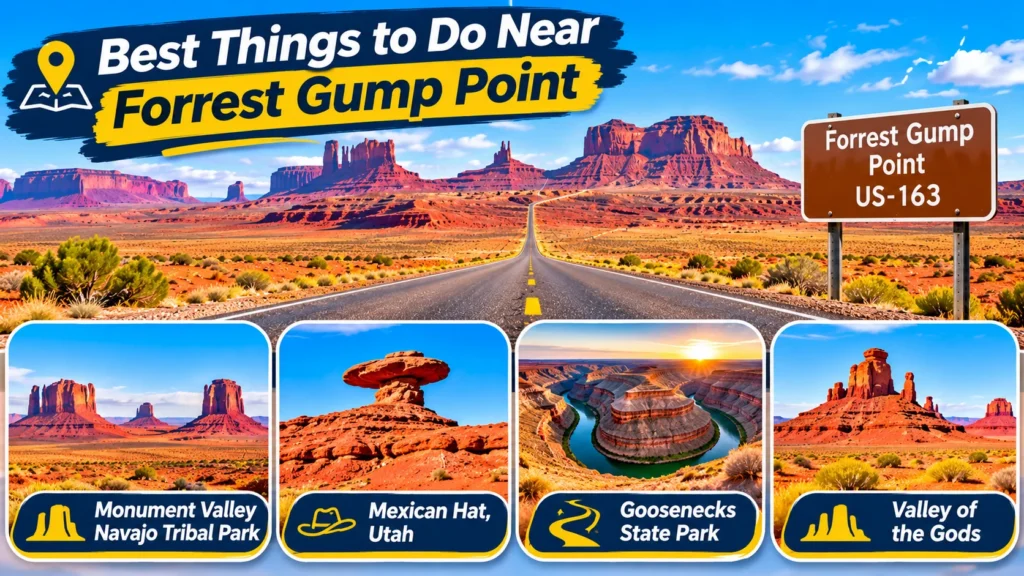
Best Things to Do Near Forrest Gump Point
One of the greatest advantages of visiting Forrest Gump Point is its location near several remarkable destinations in southeastern Utah and northern Arizona. With enough time and suitable road conditions, you can turn a short photography stop into a memorable Southwest road trip.
1. Monument Valley Navajo Tribal Park
Monument Valley is the most obvious attraction to combine with Forrest Gump Point. The landscape is famous for enormous sandstone buttes rising above the desert floor, including the recognizable East and West Mitten formations.
Visitors can experience the scenery from designated viewpoints and, when available, explore the scenic driving route or take a guided tour operated by Navajo guides. Guided experiences can also introduce visitors to the landscape’s cultural significance and access areas not open to independent travelers.
Because the park is managed by the Navajo Nation, follow its visitor rules and respect restricted areas.
Access note: Flood damage affected the park’s scenic loop in November 2026. Check current private-vehicle access and tour availability directly with Navajo Nation Parks before planning your visit.
2. Mexican Hat, Utah
Mexican Hat is a small community north of Forrest Gump Point, named after a distinctive nearby rock formation. The formation resembles a broad-brimmed hat balanced on a narrow base, making it an interesting stop for photography enthusiasts. The town is also a useful reference point when planning fuel, meals, and overnight stays in the surrounding area. Because services are limited compared with larger towns, checking availability in advance is recommended.
3. Goosenecks State Park
Goosenecks State Park offers a spectacular view of the San Juan River winding through a deep canyon. From the overlook, you can see dramatic river bends carved into the surrounding rock over millions of years.
It is an excellent destination for landscape photography, sightseeing, and appreciating the geology of the Colorado Plateau. The park charges a separate day-use fee and provides basic visitor facilities. Check the official park website for opening information and road alerts, especially following heavy rainfall or flooding.
4. Valley of the Gods
Valley of the Gods is another impressive scenic destination near Mexican Hat. Often described as a smaller-scale version of Monument Valley, the area features isolated sandstone buttes, broad desert plains, and a remote atmosphere.
A 17-mile gravel-and-clay scenic road winds through the landscape. The drive generally takes one to two hours under suitable conditions. Passenger vehicles may be able to use the road when dry, but rainfall can make the route muddy or impassable. Check local road conditions before visiting, and avoid driving through flooded washes.
A Simple Forrest Gump Point Road Trip Itinerary
If you have a full day in the Monument Valley region, consider combining the following experiences when roads and attractions are open.
Morning: Begin at Monument Valley, enjoying designated viewpoints or a prearranged Navajo-guided experience. Morning light can bring out rich colors in the sandstone formations.
Late morning: Travel north toward Forrest Gump Point. Enjoy the famous highway scenery and take photographs only from a safe roadside location.
Midday: Continue toward Mexican Hat for a meal or rest break if local services are available.
Afternoon: Visit Goosenecks State Park for its panoramic canyon views. If time, daylight, and road conditions allow, consider exploring part of Valley of the Gods.
Evening: Return to your accommodation or continue toward your next destination using a route confirmed to be open. This is a flexible sightseeing plan, not a guaranteed driving route. Recheck travel times, opening hours, and road closures before departure.
Is Forrest Gump Point Worth Visiting?
For most travelers already visiting Monument Valley or driving through southeastern Utah, Forrest Gump Point is worth considering. The location combines a famous movie scene with one of the most recognizable road landscapes in the United States. It also offers an easy way to appreciate the vast desert scenery without needing a long hike or a specialized tour. However, expectations matter.
This is a roadside viewpoint rather than a developed attraction. There may be traffic, other visitors, limited parking opportunities, and no dedicated amenities. If you are expecting a quiet pedestrian overlook with a perfectly centered road photograph, you may be disappointed. But if you enjoy scenic drives, desert landscapes, filmmaking locations, and thoughtful travel photography, the view can be a memorable part of a Utah road trip. The best experience comes from appreciating the surroundings rather than risking your safety to recreate a particular photograph.
Frequently Asked Questions About Forrest Gump Point
Where is Forrest Gump Point in Utah?
Forrest Gump Point is located along US Highway 163 near mile marker 13, between Mexican Hat and Monument Valley in southeastern Utah. Its coordinates are 37.101445, -109.990812.
What highway is Forrest Gump Point on?
The famous location is on US Highway 163, a scenic highway connecting parts of southeastern Utah and northeastern Arizona.
Where did Forrest Gump stop running?
In the 1994 movie Forrest Gump, the character stops running on a stretch of US-163 overlooking Monument Valley. That location became known as Forrest Gump Point.
Can you park at Forrest Gump Point?
There are roadside pull-offs in the area, but a safe, legal stopping space is not guaranteed. Never stop in a travel lane or block traffic. If there is no suitable place to park, continue driving.
Is Forrest Gump Point free?
Yes. Viewing the landscape from the public highway is free. Visiting Monument Valley Navajo Tribal Park is a separate experience with admission fees and visitor regulations.
What is the best time to photograph Forrest Gump Point?
Morning is generally the best time for photographs of the famous highway and Monument Valley formations. The sunlight illuminates the rocks, making their colors and details easier to capture.
How far is Forrest Gump Point from Monument Valley?
The viewpoint is roughly 12 miles north of the Monument Valley Navajo Tribal Park visitor center area, approximately a 15–20-minute drive in normal conditions.
Can you visit Forrest Gump Point at sunset?
Yes, you can drive past the viewpoint during daylight hours when the highway is open. However, the setting sun may create glare and darker rock formations in photographs. Avoid stopping or walking along the roadway in poor visibility.
Is Forrest Gump Point safe for children?
Families can enjoy the landscape from a vehicle or a lawful, safe roadside stopping location. Because the attraction lies along an active highway, adults must closely supervise children and keep them away from traffic.
Is Forest Gump Point the same as Forrest Gump Point?
Yes. Some people search for the attraction as “Forest Gump Point,” but the correct spelling is Forrest Gump Point, matching the title of the famous movie.
Final Thoughts: Visiting Forrest Gump Point in Utah
Forrest Gump Point is more than a memorable location from a Hollywood movie. It is also one of the most scenic stretches of highway in the American Southwest, offering beautiful views of Monument Valley and the surrounding red desert landscape.
Whether you are planning a Utah road trip, exploring nearby Navajo Tribal Park attractions, or simply hoping to capture a beautiful photograph, this iconic location can be a rewarding stop.
Remember to confirm your route before traveling, choose a safe and lawful stopping location, and never enter active traffic lanes for photographs.
With thoughtful planning and respect for the area, Forrest Gump Point can become a memorable highlight of your journey through Utah and Arizona.