
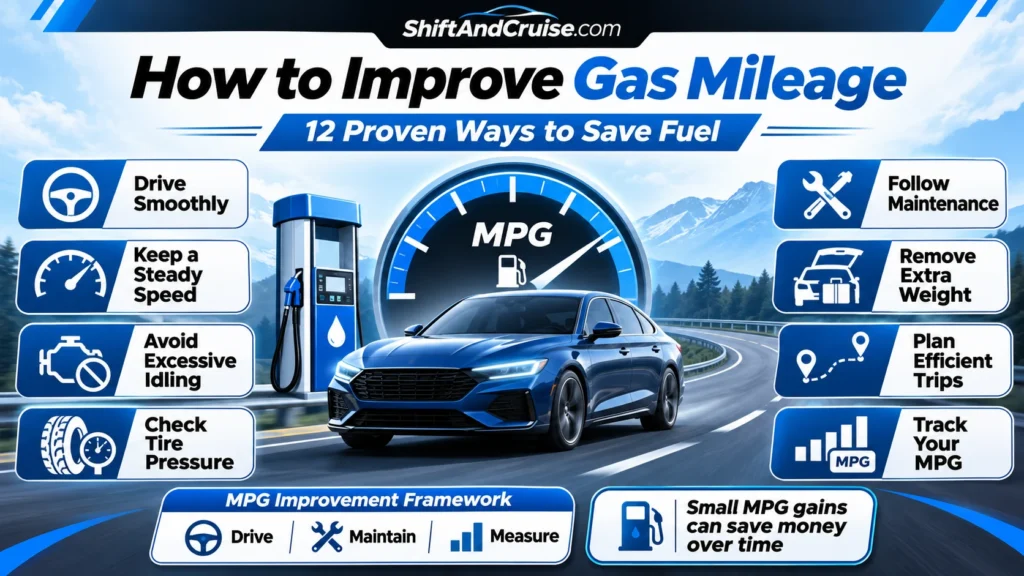
Improving your car’s fuel economy doesn’t require expensive modifications or buying a new vehicle. The biggest improvements often come from smarter driving habits, proper maintenance, and reducing unnecessary fuel consumption.
If you’re wondering how to improve gas mileage, start with three priorities: drive smoothly, maintain correct tire pressure, and avoid excessive highway speeds.
According to the U.S. Department of Energy, aggressive driving can reduce fuel economy by approximately 15–30% on highways and 10–40% in stop-and-go traffic. Actual savings depend on your vehicle, driving conditions, and current habits. Driving More Efficiently
This guide covers 12 practical fuel-saving methods, an original MPG improvement framework, and a simple way to measure your results.
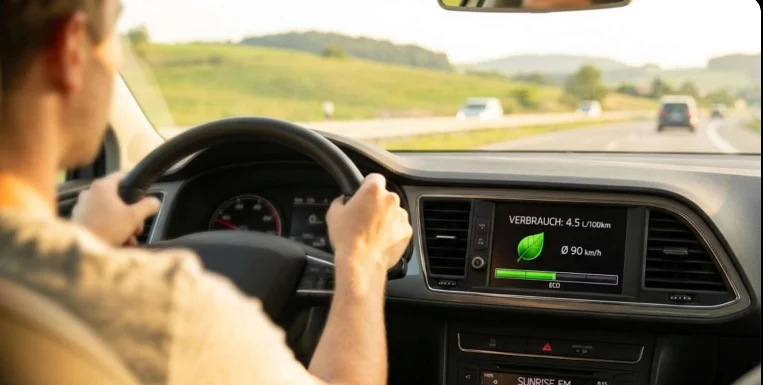
Driving Habits That Improve Fuel Economy
Spritverbrauch senken mit „Sweetspot-Methode“: Autofahrer sparen Hunderte Euro
ruhr24.de
Accelerate Smoothly and Avoid Hard Braking
Rapid acceleration forces your engine to consume more fuel, while unnecessary braking wastes energy already used to move the vehicle.
Instead:
- Accelerate gradually from traffic lights.
- Maintain a safe following distance.
- Anticipate traffic conditions ahead.
- Release the accelerator early when approaching stops.
Smooth driving helps maintain momentum without compromising safety.
Maintain a Consistent Highway Speed
Higher speeds increase aerodynamic resistance, making the engine work harder.
Fuel economy generally decreases noticeably above 50 mph, although the most efficient cruising speed varies by vehicle. Driving More Efficiently
Use cruise control on suitable, dry highways to maintain consistent speed. Avoid using it on slippery roads or where frequent speed adjustments are necessary.
Reduce Excessive Idling
An idling engine burns gasoline without moving your car.
Depending on engine size and air-conditioning use, idling can consume approximately 0.25–0.5 gallons per hour. Driving More Efficiently
Turn off the engine during extended parking stops when safe and appropriate. Do not switch it off while moving or stopped temporarily in active traffic.
Use ECO Mode When Appropriate
Many modern vehicles include an ECO driving mode that adjusts throttle response, transmission behavior, or climate-control operation.
ECO mode may help reduce unnecessary fuel consumption, particularly during city driving. However, the actual benefit varies by vehicle and driver behavior.
It cannot compensate for aggressive acceleration or poor maintenance.
Vehicle Maintenance That Helps Save Gas
Lufttryck däck tabell: Rätt tryck per däckdimension (bar & PSI)
hittadackverkstad.se
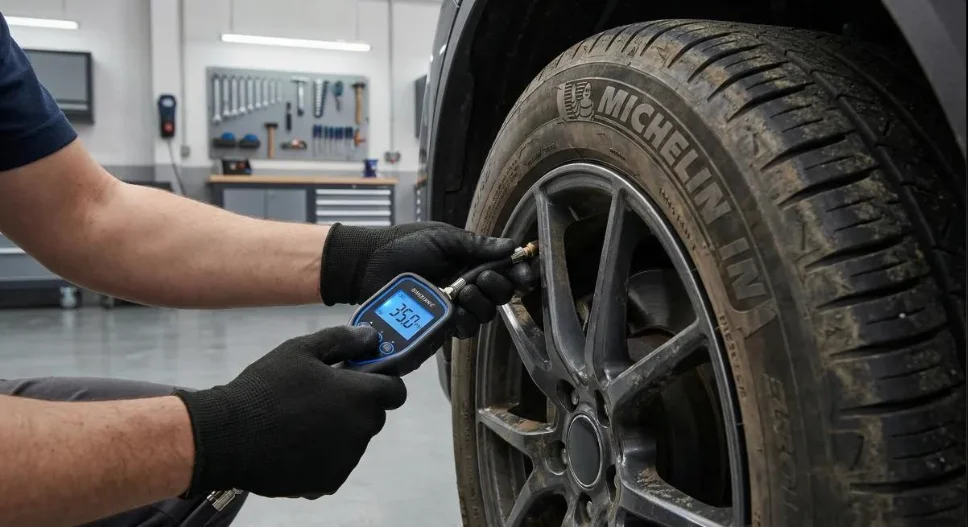
Maintain the Correct Tire Pressure
Underinflated tires increase rolling resistance and can reduce fuel efficiency.
The Department of Energy estimates that correct tire inflation improves mileage by approximately 0.6% on average, with greater improvements possible in some situations. Keeping Your Vehicle in Shape
Check tire pressure when tires are cold, using the pressure specified on your vehicle’s door-jamb label or owner’s manual—not the maximum printed on the tire sidewall.
Follow Your Vehicle’s Maintenance Schedule
Regular servicing helps preserve engine performance and fuel efficiency.
Prioritize:
- Manufacturer-recommended engine oil.
- Spark plugs at their specified replacement intervals.
- Inspection of worn or dragging brakes.
- Wheel alignment when symptoms indicate a problem.
- Prompt diagnosis of check-engine warnings.
A dirty air filter should be replaced when needed, but replacing one on a modern fuel-injected gasoline vehicle does not necessarily improve MPG.
Remove Unnecessary Weight and Roof Accessories
Additional cargo requires more energy to accelerate, while external roof storage increases aerodynamic drag.
The Department of Energy estimates that carrying an additional 100 pounds can reduce fuel economy by approximately 1%, depending on the vehicle. Driving More Efficiently
Remove unused roof boxes, heavy tools, and unnecessary cargo, but always retain essential emergency equipment.
The Three-Layer MPG Improvement Framework
Rather than making random changes, use this practical framework to prioritize improvements.
| Layer | Main Action | Priority |
|---|---|---|
| Driving | Smooth acceleration, appropriate speed, less idling | High |
| Maintenance | Tire pressure, correct oil, resolving mechanical faults | High |
| Trip efficiency | Combining errands, reducing cargo, choosing efficient routes | Medium |
Start with driving habits because they offer substantial potential savings without requiring replacement parts.
Then correct maintenance issues and improve trip planning.
How Much Money Could Better MPG Save?
The following hypothetical comparison assumes 12,000 miles of annual driving and gasoline costing $3.50 per gallon.
| Average MPG | Annual Fuel Cost | Annual Savings |
|---|---|---|
| 25 MPG | $1,680 | Baseline |
| 27 MPG | $1,556 | $124 |
| 30 MPG | $1,400 | $280 |
| 33 MPG | $1,273 | $407 |
These are calculated examples, not guaranteed improvements. Increasing fuel economy from 25 to 30 MPG represents a 20% improvement and approximately $280 in yearly savings under these assumptions.
Smart Trip Planning and Measuring Your Results
Miami rental sat nav vs phone maps: what’s best? – Hola Car Rentals
holacarrentals.com
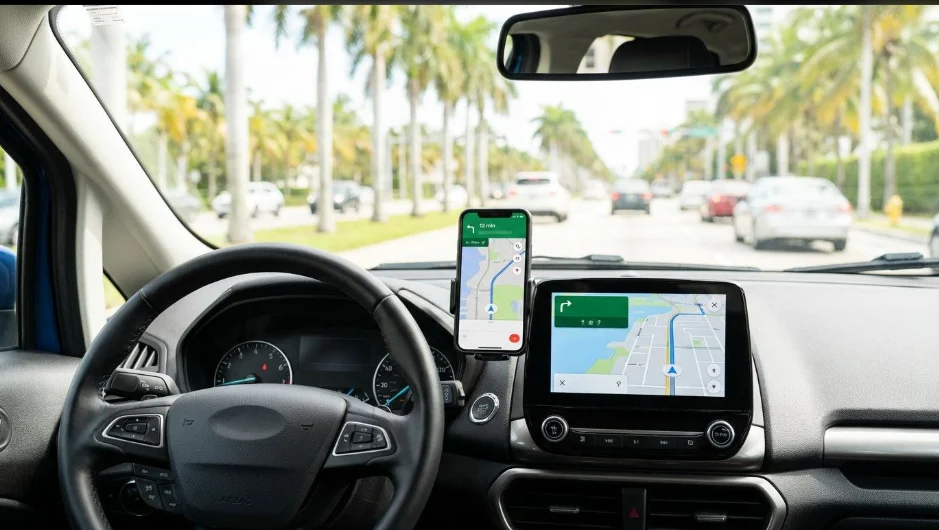
Combine Short Trips
Cold engines generally operate less efficiently than warmed-up engines.
Combining grocery shopping, appointments, and other errands into one outing can reduce repeated cold starts and unnecessary miles.
Choose routes that balance distance, congestion, and driving conditions rather than automatically selecting the shortest route.
Use Air Conditioning Efficiently
Air conditioning increases engine workload, but driving with open windows at highway speeds can increase aerodynamic drag.
Ventilate a hot parked vehicle before driving, use a comfortable temperature setting, and avoid unnecessary maximum cooling.
Avoid Unnecessary Premium Gasoline
Premium gasoline does not automatically produce better mileage.
Use the octane rating recommended or required by your manufacturer. Paying for higher octane than necessary may provide no meaningful fuel-economy benefit.
Track Your Real-World MPG
Use this simple 14-Day Fuel Efficiency Test to evaluate whether your changes work.
- Fill the tank completely and reset the trip meter.
- Drive normally for one week and record miles and refill gallons.
- Calculate baseline MPG: miles driven ÷ gallons used.
- During the second week, practice smoother acceleration, reduce unnecessary idling, and maintain proper tire pressure.
- Recalculate MPG and compare results.
For reliable results, use several full-tank measurements with similar routes, weather, and traffic conditions. A single week can be misleading.
If mileage suddenly declines, check for mechanical problems before assuming your driving style is responsible.
Final Takeaway
Learning how to improve gas mileage is about reducing wasted energy rather than chasing expensive fuel-saving products.
Start with smooth driving, correct tire pressure, responsible highway speeds, regular maintenance, and efficient trip planning.
Measure fuel economy consistently and prioritize changes that actually reduce gallons consumed. Even modest MPG gains can produce worthwhile savings over thousands of miles without sacrificing driving safety or comfort.