
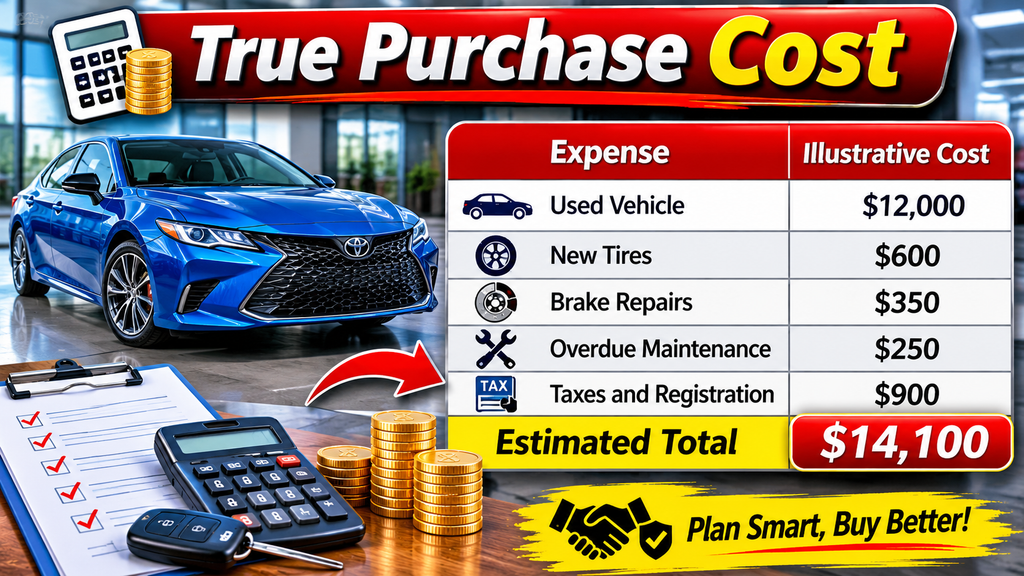
Buying a used vehicle can save thousands compared with purchasing new, but not every secondhand car offers the same protection. Some vehicles include manufacturer-backed warranties and documented inspections, while others are sold with limited coverage or entirely as-is.
Understanding certified pre owned vs used car differences helps buyers compare purchase prices, mechanical risks, warranty benefits, and long-term ownership costs.
Quick Answer: A certified pre-owned (CPO) car is a used vehicle that meets specific certification requirements and typically includes additional warranty protection. A regular used car generally costs less but may offer fewer guarantees. The better choice depends on vehicle reliability, inspection results, warranty terms, and the price difference.
At ShiftAndCruise, we recommend evaluating both options through a Price–Protection–Condition Framework rather than assuming certification automatically guarantees a better vehicle.
What Is a Certified Pre-Owned Car?
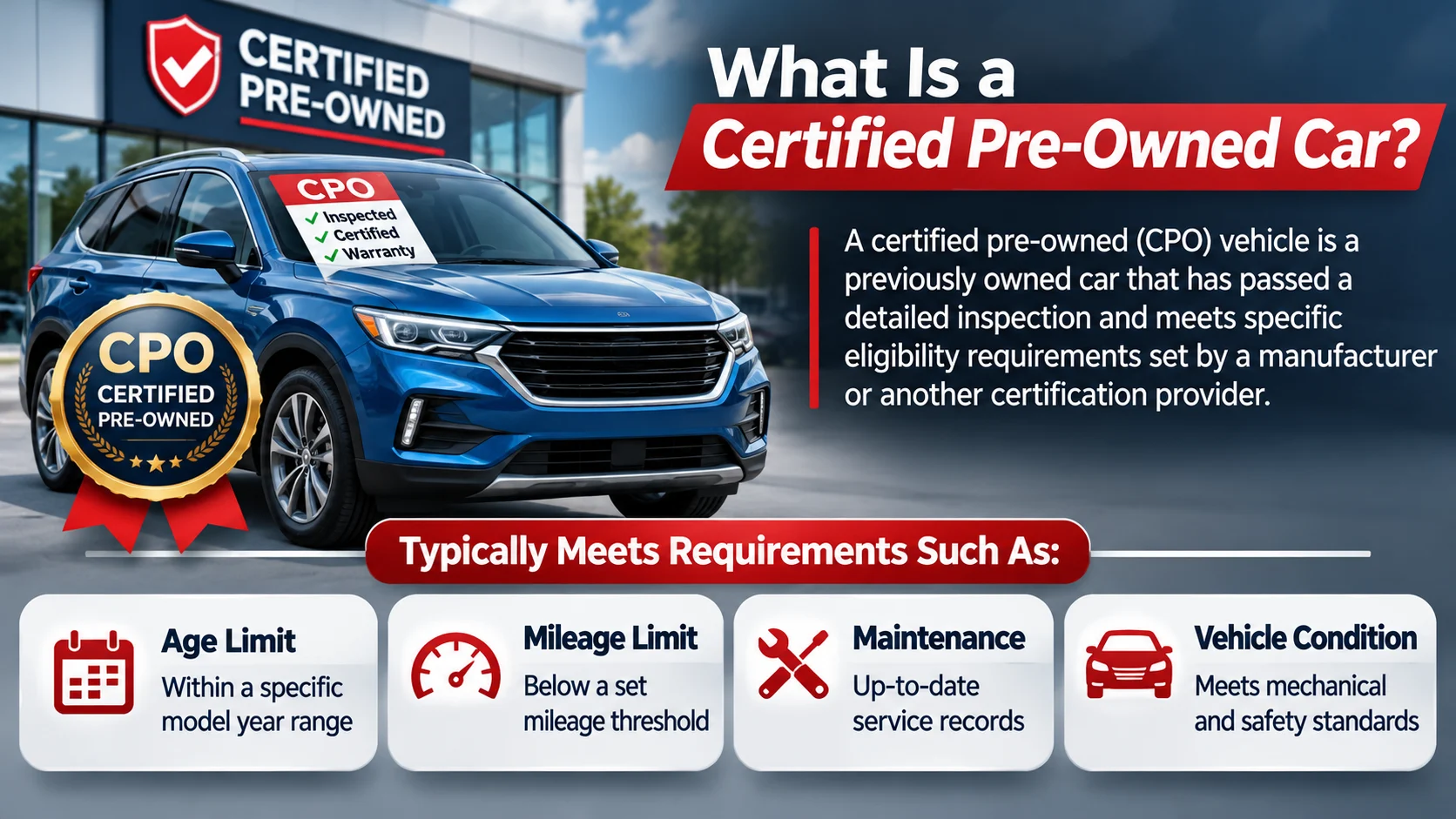
A certified pre-owned vehicle is a previously owned car that has passed an inspection and meets eligibility requirements established by a manufacturer or another certification provider.
Genuine manufacturer-backed CPO programs typically require vehicles to meet standards involving age, mileage, maintenance, and mechanical condition.
What Does CPO Certification Include?
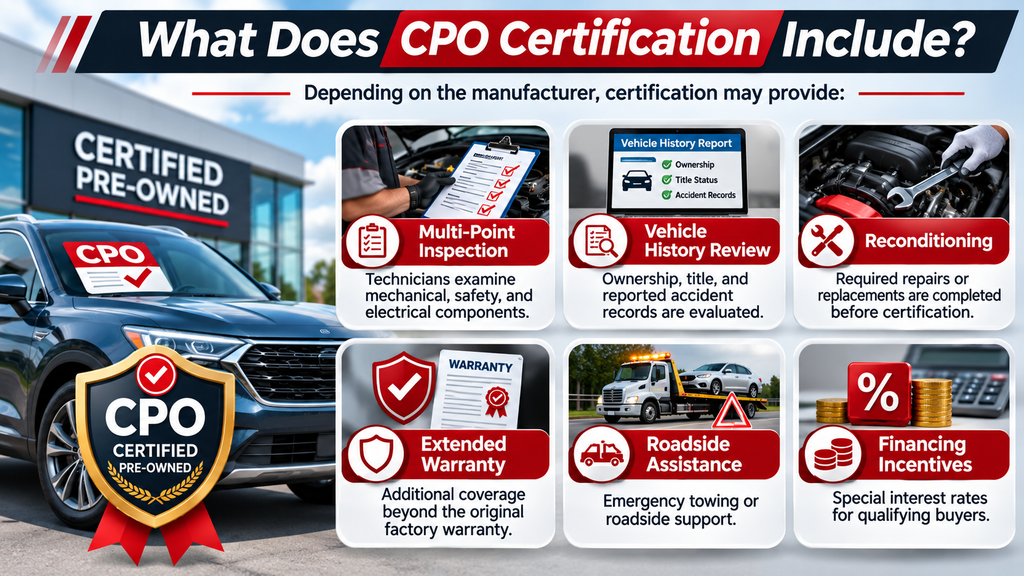
Depending on the manufacturer, certification may provide:
- Multi-point inspection: Technicians examine mechanical, safety, and electrical components.
- Vehicle history review: Ownership, title, and reported accident records are evaluated.
- Reconditioning: Required repairs or replacements are completed before certification.
- Extended warranty: Additional coverage beyond the original factory warranty.
- Roadside assistance: Emergency towing or roadside support.
- Financing incentives: Special interest rates for qualifying buyers.
According to Edmunds, certification requirements and warranty benefits vary between automakers.
Manufacturer-Certified vs. Dealer-Certified Cars
Not every vehicle advertised as certified belongs to an official manufacturer program.
Manufacturer-certified vehicles generally receive warranty backing from the automaker and must satisfy its certification standards.
Dealer-certified vehicles may use dealership-specific inspections or third-party service contracts.
Before purchasing, request written confirmation identifying the certification provider and warranty administrator.
Certified Pre-Owned vs. Used Car: Key Differences
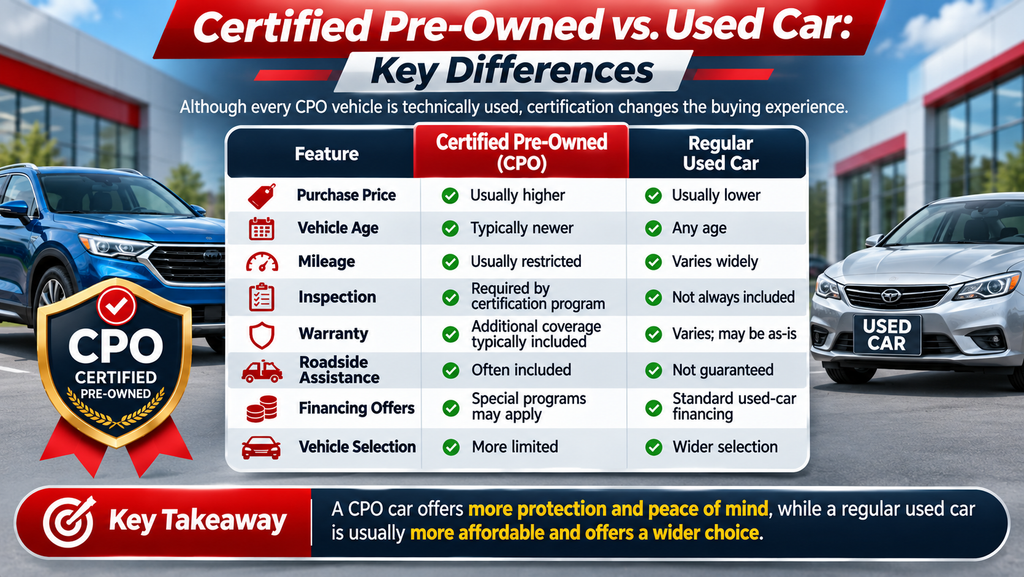
Although every CPO vehicle is technically used, certification changes the buying experience.
CPO vs. Used Car Comparison
| Feature | Certified pre-owned | Regular used car |
|---|---|---|
| Purchase price | Usually higher | Usually lower |
| Vehicle age | Typically newer | Any age |
| Mileage | Usually restricted | Varies widely |
| Inspection | Required by certification program | Not always included |
| Warranty | Additional coverage typically included | Varies; may be as-is |
| Roadside assistance | Often included | Not guaranteed |
| Financing offers | Special programs may apply | Standard used-car financing |
| Vehicle selection | More limited | Wider selection |
Reliability and Mechanical Condition
Certification can provide additional assurance, but it cannot eliminate mechanical problems.
A 2026 Consumer Reports analysis found that certified pre-owned vehicles had approximately 14% fewer owner-reported problems than other used vehicles in its survey analysis.
However, individual reliability still depends on the vehicle’s model, maintenance history, and condition.
A well-maintained noncertified vehicle may outperform a poorly maintained certified alternative.
Warranty Coverage and Limitations
CPO warranties can offer valuable protection against covered repairs.
However, coverage periods, deductibles, exclusions, and eligible repair locations vary.
Some warranties cover powertrain components only, while others offer broader protection.
Buyers should read the actual warranty agreement rather than relying on promotional descriptions.
Is a Certified Pre-Owned Car Worth the Extra Money?
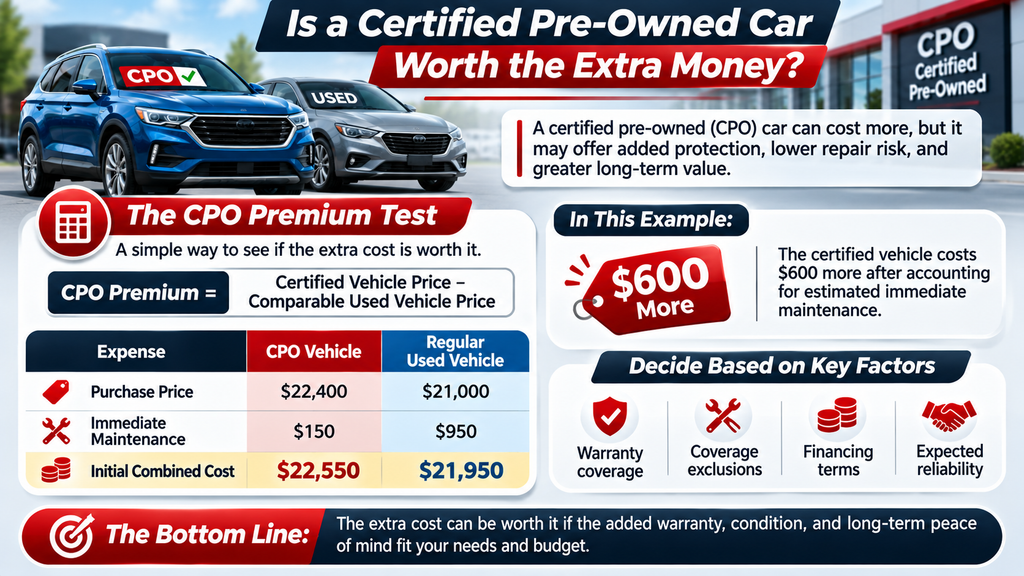
The biggest question in a certified pre owned vs used car comparison is whether the additional purchase cost delivers meaningful value.
ShiftAndCruise’s CPO Premium Test provides a practical way to evaluate that difference.
Calculate the Certification Premium
CPO Premium = Certified Vehicle Price − Comparable Used Vehicle Price
Consider this hypothetical comparison:
| Expense | CPO vehicle | Regular used vehicle |
|---|---|---|
| Purchase price | $22,400 | $21,000 |
| Immediate maintenance | $150 | $950 |
| Initial combined cost | $22,550 | $21,950 |
In this example, the certified vehicle costs $600 more after accounting for estimated immediate maintenance.
Whether that premium is worthwhile depends on the additional warranty, coverage exclusions, financing terms, and expected reliability.
These numbers are illustrative, not market averages. Warranty coverage does not guarantee future savings.
When CPO Makes More Sense
A certified vehicle may be preferable when:
- You want additional manufacturer-backed warranty coverage.
- You plan to keep the vehicle for several years.
- You prefer newer vehicles with lower mileage.
- The certification premium is relatively small.
- Special financing reduces borrowing costs.
When a Regular Used Car Makes More Sense
A noncertified vehicle may offer better value when:
- Your primary goal is minimizing the purchase price.
- The vehicle has reliable maintenance documentation.
- An independent inspection confirms acceptable condition.
- You have savings available for unexpected repairs.
- The comparable CPO vehicle carries a substantial premium.
The cheapest option is not automatically the best value.
How to Choose Between CPO and Regular Used Cars
Before deciding, apply the Three-Check Buying Framework to both vehicles.
Check the Vehicle’s History
Request the VIN and examine available ownership, accident, maintenance, and title records.
Use the NHTSA recall checker to investigate outstanding safety recalls.
A clean history report does not guarantee that a vehicle has never suffered damage.
Check the Mechanical Condition
Arrange an independent pre-purchase inspection, even when purchasing a certified vehicle.
The Federal Trade Commission recommends independent mechanical inspections for dealer-sold used cars, including certified vehicles.
Ask the mechanic to inspect the engine, transmission, suspension, brakes, tires, and signs of previous damage.
Check the Total Ownership Cost
Compare more than the advertised price.
Evaluate:
- Vehicle purchase price and taxes.
- Registration and dealership fees.
- Loan interest and financing terms.
- Immediate repairs and maintenance.
- Warranty coverage and potential deductibles.
For dealer purchases, review the FTC Buyers Guide and obtain all warranty promises in writing.
A detailed used car inspection checklist can help you organize these checks before making an offer.
Final Verdict: Which Should You Buy?
The certified pre owned vs used car decision comes down to balancing affordability, mechanical condition, and warranty protection.
Choose a certified pre-owned vehicle when the additional warranty benefits and verified condition justify the higher price.
Choose a regular used vehicle when its history, independent inspection, and lower total cost provide stronger overall value.
Neither option is automatically safer or more reliable simply because of its label.
The smartest purchase is the vehicle with a verified history, acceptable mechanical condition, clear warranty terms, and a total price that fits your budget.